Klassifizierung / Names
Namen | Synonyme | Catalog of Fishes(Gattung, Arten) | ITIS | CoL | WoRMS | Cloffa
Umwelt: Milieu / Klimazone / Tiefenbereich / Verbreitungsgebiet
Ökologie
; süßwasser demersal. Tropical
South America: Brazil.
Größe / Gewicht / Alter
Geschlechtsreife: Lm ? range ? - ? cm
Max length : 3.7 cm SL Männchen/unbestimmt; (Ref. 138443)
Kurzbeschreibung
Bestimmungsschlüssel | Morphologie | Morphometrie
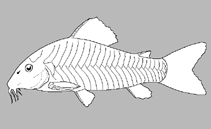
This species is distinguished by the following characters: posterior margin of pectoral-fin spine with most serrations directed towards the tip of the spine; presence of contact between nuchal plate and posterior process of the parieto-supraoccipital; anterior laminar expansion of infraorbital 1 strongly well developed, conspicuously expanded towards the anteroventral portion of snout, significantly covering its lateral surface. Colouration: light ground color of body, and with greenish yellow iridescent coloration when alive; absence of a large-sized dark blotch on caudal-fin base; with dark brown or black markings on fins, except for the pelvic fin; with dark brown or black markings on head; flank midline covered by small-sized dark brown or black blotches; flank midline variably with distinct longitudinal series of blotches, generally more evident on posterior half of flank (Ref. 138443).
Body shape (shape guide): fusiform / normal; Cross section: oval.
Inhabits the main channel of the rio Jamanxim to its small tributary streams; mostly associated with the margins of the river, where juvenile specimens were observed shoaling together with juvenile and adult specimens of C. hypnos in the sandy shores, both species in relatively high abundance. In small streams, adult and juvenile specimens were found shoaling together with juvenile and adult specimens of C. hypnos, generally in sites with submerged branches, leaf litter, and sandy and/or fine gravel substrate, with C. thanatos in higher numbers than C. hypnos. This fish was mostly observed and captured at night (Ref. 138443).
Lebenszyklus und Paarungsverhalten
Geschlechtsreife | Fortpflanzung | Ablaichen | Eier | Fruchtbarkeit | Larven
Tencatt, L.F.C., W.M. Ohara, L.M. de Sousa and M.R. Britto, 2022. Science and hobby joining forces for the discovery of three new Corydoras (Siluriformes: Callichthyidae) from the rio Tapajós basin, Brazil, with comments on Corydoras sp. CW111. Neotropical Ichthyology v. 20 (no. 3): e220070: 1-40. (Ref. 138443)
IUCN Rote Liste Status (Ref. 130435: Version 2025-2 (Global))
Bedrohung für Menschen
Harmless
Nutzung durch Menschen
Tools
Zusatzinformationen
Download XML
Internet Quellen
Schätzungen auf der Grundlage von Modellen
Phylogenetischer Diversitätsindex (Ref.
82804): PD
50 = 0.5000 [Uniqueness, from 0.5 = low to 2.0 = high].
Bayesian length-weight: a=0.01778 (0.00758 - 0.04173), b=3.02 (2.82 - 3.22), in cm total length, based on LWR estimates for this (Sub)family-body shape (Ref.
93245).
Trophische Ebene (Ref.
69278): 3.0 ±0.4 se; based on size and trophs of closest relatives
Widerstandsfähigkeit (Ref.
120179): hoch, Verdopplung der Population dauert weniger als 15 Monate. (Preliminary K or Fecundity.).
Anfälligkeit der Fischerei (Ref.
59153): Low vulnerability (10 of 100).
🛈