Clasificación / Nombres
Nombres comunes | Sinónimos | Catalog of Fishes(Género, Especie) | ITIS | CoL | WoRMS | Cloffa
>
Siluriformes (Catfishes) >
Loricariidae (Armored catfishes) > Hypostominae
Etymology: Baryancistrus: Greek, barys = heavy + Greek, agkistron = hook (Ref. 45335); isaaci: Name 'isaaci' in honor of Isaäc Isbrücker, for his contribution to the knowledge of Neotropical Ichthyology, especially loricariids.
Entorno: milieu / zona climática / rango de profundidad / gama de distribución
Ecología
; agua dulce demersal. Tropical
South America: Brazil.
Tamaño / Peso / Edad
Madurez: Lm ? range ? - ? cm
Max length : 27.0 cm SL macho / no sexado; (Ref. 138404)
Descripción breve
Claves de identificación | Morfología | Morfometría
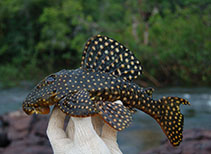
Espinas dorsales (total) : 2; Radios blandos dorsales (total) : 7; Radios blandos anales: 4. This species is distinguished from its congeners by the following set of characters: large and yellow dots, larger than pupil and distant from each other; abdominal area covered by plates; dorsal-fin posterior membrane reaching or almost reaching the preadipose plate, leaving just one plate between the membrane and the preadipose plate; distance between the dorsal and adipose fins 0.0-2.5% of SL; postdorsal length 23.2-26.2% of SL; lack of a yellow-orange bar on the distal border of dorsal and caudal fins in juveniles and adult specimens; and orbit diameter 18.5-26.0% of HL (Ref. 138404).
Body shape (shape guide): elongated; Cross section: oval.
Ciclo vital y comportamiento de apareamiento
Madurez | Reproducción | Puesta | Huevos | Fecundidad | Larva
de Oliveira, R.R. and L.H.R. Py-Daniel, 2025. Two new species of the ornamental loricariid genus Baryancistrus (Siluriformes: Hypostominae) from rio Trombetas basin, Pará, Brazil. Neotrop. Ichthyol. 23(3):e250066. (Ref. 138404)
Situación en la Lista Roja de la UICN (Ref. 130435: Version 2025-2 (Global))
Amenaza para el ser humano
Harmless
Usos humanos
Pesquerías: sin interés
Herramientas
Informes especiales
Descargar XML
Fuentes de Internet
Estimaciones basadas en modelos
Índice de diversidad filogenética (Referencia
82804): PD
50 = 0.5039 [Uniqueness, from 0.5 = low to 2.0 = high].
Bayesian length-weight: a=0.01549 (0.00726 - 0.03306), b=2.96 (2.79 - 3.13), in cm total length, based on LWR estimates for this (Sub)family-body shape (Ref.
93245).
Resiliencia (Referencia
120179): Medio, población duplicada en un tiempo mínimo de 1.4-4.4 años (Preliminary K or Fecundity.).
Vulnerabilidad pesquera (Ref.
59153): Low vulnerability (23 of 100).
🛈