Classificação / Nomes
Nomes comuns | Sinónimos | Catalog of Fishes(Género, Espécies) | ITIS | CoL | WoRMS | Cloffa
>
Siluriformes (Catfishes) >
Callichthyidae (Callichthyid armored catfishes) > Corydoradinae
Etymology: Aspidoras: Greek, aspis, -idos = shield + Greek, dora = skin (Ref. 45335); aldebaran: Named after the red giant Aldebaran or Alpha Tauri (α Tauri), the brightest star of the Taurus constellation, deriving from the Arabic al Dabarān, which means 'the follower', This star presents a bright orange glow and it is positioned at the left eye of the mythological bull. A. aldebaran was firstly found among the Aspidoras taurus type series, recognized as a different and new species by its peculiar morphology and color pattern; noun in apposition.
Ambiente: milieu / zona climática / intervalo de profundidade / gama de distribuição
Ecologia
; Água doce demersal; intervalo de profundidade 0 - 1 m (Ref. 129024). Tropical
South America: Brazil.
Tamanho / Peso / Idade
Maturidade: Lm ? range ? - ? cm
Max length : 3.1 cm SL macho/indeterminado; (Ref. 129024)
Descrição breve
Chaves de identificação | Morfologia | Morfometria
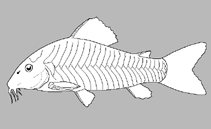
This species is distinguished from its congeners by the following characters: parapophysis of the complex vertebra well developed; inner laminar expansion of infraorbital 1 ranging from well developed to extremely well developed; frontal bone narrow, with width slightly smaller than half of entire length; presence of small black spots on dorsal fin (Ref. 129024).
Body shape (shape guide): elongated; Cross section: oval.
The site where some of the paratypes were collected, córrego Gordura, is a medium-sized tributary to the upper rio Araguaia basin with highly transparent and clear water, width ranging from less than one meter to about 15 m, and the depth ranging from about 10 cm to nearly two meters. The species was found in shallow (up to about 20 cm) stretches in the upper portion of the córrego Gordura, with moderate current and substrate composed mainly by sand and gravel. At this site, it was found in syntopy with Aspidoras velites, Characidium sp., and Hypostomus cf. careopinnatus. This species and A. velites were placed in a small biotope aquarium (i.e., one that recreates the natural habitat) to record their color pattern in life. During this event, A. velites displayed aggressive behavior towards an A. aldebaran, chasing and pushing it throughout the aquarium, with the latter specimen not reacting aggressively but tried to evade the assaults by the A. velites. Interestingly, A. aldebaran is generally larger and a clearly more robust than A. velites. In nature, such confrontations seem unlikely considering that the A. aldebaran was generally found associated with the sandy substrate of small shores whereas A. velites was most commonly captured in areas associated with marginal and/or submerged vegetation (Ref. 129024).
Ciclo de vida e comportamento de acasalamento
Maturidade | Reprodução | Desova | Ovos | Fecundidade | Larvas
Tencatt, L.F.C., M.R. Britto, I.J.H. Isbrücker and C.S. Pavanelli, 2022. Taxonomy of the armored catfish genus Aspidoras (Siluriformes: Callichthyidae) revisited, with the description of a new species. Neotropical Ichthyology 20(3):1-159. (Ref. 129024)
Categoria na Lista Vermelha da IUCN (Ref. 130435: Version 2025-2 (Global))
Ameaça para o homem
Harmless
Utilização humana
Ferramentas
Relatórios especiais
Descarregue XML
Fontes da internet
Estimativas baseadas em modelos
Índice de diversidade filogenética (Ref.
82804): PD
50 = 0.5000 [Uniqueness, from 0.5 = low to 2.0 = high].
Bayesian length-weight: a=0.00741 (0.00287 - 0.01912), b=3.14 (2.92 - 3.36), in cm total length, based on LWR estimates for this (Sub)family-body shape (Ref.
93245).
Nível Trófico (Ref.
69278): 3.0 ±0.3 se; based on size and trophs of closest relatives
Resiliência (Ref.
120179): Elevada, tempo mínimo de duplicação da população menor que 15 meses (Preliminary K or Fecundity.).
Vulnerabilidade da pesca (Ref.
59153): Low vulnerability (10 of 100).
🛈