Clasificación / Nombres
Nombres comunes | Sinónimos | Catalog of Fishes(Género, Especie) | ITIS | CoL | WoRMS | Cloffa
>
Siluriformes (Catfishes) >
Callichthyidae (Callichthyid armored catfishes) > Corydoradinae
Etymology: reisi: Named after Roberto Esser dos Reis, for his many contributions to Neotropical ichthyology, including studies in callichthyid fish; noun in the genitive case.
Eponymy: Dr Roberto Esser dos Reis is a Brazilian ichthyologist. [...] (Ref. 128868), visit book page.
Entorno: milieu / zona climática / rango de profundidad / gama de distribución
Ecología
; agua dulce bentopelágico; rango de profundidad 0 - 1 m (Ref. 138468). Tropical
Distribución
Territorios | Áreas FAO | Ecosistemas | Ocurrencias, apariciones | Mapa de puntos | Introducciones | Faunafri
South America: Brazil.
Tamaño / Peso / Edad
Madurez: Lm ? range ? - ? cm
Max length : 5.4 cm SL macho / no sexado; (Ref. 138468)
Descripción breve
Claves de identificación | Morfología | Morfometría
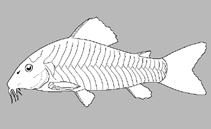
This species is distinguished by the following characters: infraorbital 2 expanded ventrally, adjacent to small, almost imperceptible, naked area between sphenotic, compound pterotic, opercle and preopercle; with a roughly oblique, elongate, dark brown blotches along body; large specimens with cranial fontanel completely occluded, leaving just a shallow fossae, delimited by frontal bones, and reaching
anterior tip of parieto-supraoccipital; absence of a black dot on the base of median caudal-fin rays and sexually dimorphic features inconspicuous, i.e. cheek
region similar in males and females, with only minute, scattered odontodes in the former, dorsal and pectoral fins of males slightly longer than in females; tip of snout roughly truncate (Ref. 138468).
Body shape (shape guide): elongated; Cross section: oval.
This species was found mainly in very small (0.5-2 m wide) and shallow streams (30-60 cm depth), with slow current water and surrounded by relatively preserved riparian vegetation; bottom was sandy, sometimes covered with a thin layer of mud or fallen leaves (although there were rocky bottom stretches in the same creeks, the species was never found there). The streams may have a small amount of submerged vegetation. Associated species collected along with this species were Astyanax eigenmanniorum, Cheirodon interruptus, Corydoras paleatus, Heptapterus mustelinus, H. sympterygium, Mimagoniates inequalis, Phalloceros caudimaculatus, Pseudobunocephalus iheringii, Rhamdia sp. and Scleronema sp. (Ref. 138468).
Ciclo vital y comportamiento de apareamiento
Madurez | Reproducción | Puesta | Huevos | Fecundidad | Larva
Britto, M.R., C.K. Fukakusa and L.R. Malabarba, 2016. New species of Scleromystax Günther, 1864 (Siluriformes: Callichthyidae) - extending the meridional distribution of genera endemic to the Atlantic Forest. Neotropical Ichthyol. 14(3):e150158: [1-10]. (Ref. 138468)
Situación en la Lista Roja de la UICN (Ref. 130435: Version 2025-2 (Global))
Amenaza para el ser humano
Harmless
Usos humanos
Herramientas
Informes especiales
Descargar XML
Fuentes de Internet
Estimaciones basadas en modelos
Índice de diversidad filogenética (Referencia
82804): PD
50 = 0.5078 [Uniqueness, from 0.5 = low to 2.0 = high].
Bayesian length-weight: a=0.00741 (0.00287 - 0.01912), b=3.14 (2.92 - 3.36), in cm total length, based on LWR estimates for this (Sub)family-body shape (Ref.
93245).
Nivel trófico (Referencia
69278): 3.0 ±0.3 se; based on size and trophs of closest relatives
Resiliencia (Referencia
120179): Alto, población duplicada en un tiempo mínimo inferior a 15 meses (Preliminary K or Fecundity.).
Vulnerabilidad pesquera (Ref.
59153): Low vulnerability (10 of 100).
🛈