Ελασμοβράγχιοι (καρχαρίες και σαλάχια) (sharks and rays) >
Squaliformes (Sleeper and dogfish sharks) >
Oxynotidae (Rough sharks)
Etymology: Oxynotus: oxys (Gr.), sharp; notos (Gr.), back, referring to its keeled back (“dorso carenato”) (See ETYFish); bruniensis: -ensis, Latin suffix denoting place: the shore of Bruny Island, Tasmania, where holotype was discovered in a “dried … but fair state of preservation” (See ETYFish).
More on author: Ogilby.
Περιβάλλον: περιβάλλον / κλιματική ζώνη / εύρος βάθους / εύρος διανομής
Οικολογία
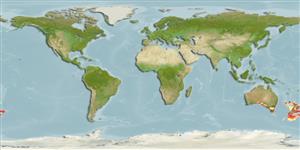
Θαλασσινό(ά) βαθύβιο(ς); εύρος βάθους 45 - 1070 m (Ref. 26346), usually 350 - 650 m (Ref. 6871). Deep-water; 31°S - 55°S, 125°E - 172°W (Ref. 54691)
Southwest Pacific: confined to temperate waters off southern Australia and New Zealand.
Μήκος κατά την πρώτη ωρίμανση / Μέγεθος / Βάρος / Ηλικία
Γεννητική Ωρίμανση: Lm ?, range 60 - ? cm
Max length : 65.0 cm TL αρσενικό/απροσδιόριστο; (Ref. 122636); 74.0 cm TL (female); μεγ. δημοσιευμένο βάρος: 6.6 kg (Ref. 122636)
Σύντομη περιγραφή
Κλείδες προσδιορισμού | Μορφολογία | Μορφομετρία
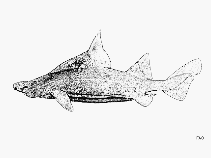
Εδρικές άκανθες: 0. Uniform grey-brown coloration; short, blunt snout; high sail-like dorsal fins with spines and broad apices, first dorsal spine inclined backward; high, thick triangular body with large, rough denticles; circular spiracles; lanceolate upper teeth, lower blade-like teeth in less than 12 rows (Ref. 247).
Body shape (shape guide): elongated.
Found on outer continental and insular shelves and uppermost slopes (Ref. 247). Probably feeds on bottom invertebrates and fishes. Ovoviviparous (Ref. 205). Taken incidentally with bottom trawls but probably not used (Ref. 247).
Ovoviviparous, with 7 young in a litter (Ref. 247). Size at birth about 24 cm (Ref. 6871). Distinct pairing with embrace (Ref. 205).
Compagno, L.J.V., 1984. FAO Species Catalogue. Vol. 4. Sharks of the world. An annotated and illustrated catalogue of shark species known to date. Part 1 - Hexanchiformes to Lamniformes. FAO Fish. Synop. 125(4/1):1-249. Rome, FAO. (Ref. 247)
Κατάσταση Κόκκινου Καταλόγου IUCN (Ref. 130435: Version 2025-2 (Global))
Απειλή για τον άνθρωπο
Harmless
Ανθρώπινες χρήσεις
αλιεία: χωρίς ενδιαφέρον
Εργαλεία
Ειδικές εκθέσεις
Λήψη XML
Διαδικτυακές πηγές
Εκτιμήσεις βάσει μοντέλων
Προτιμώμενη θερμοκρασία (Αναφ.
123201): 6.2 - 10.4, mean 8 °C (based on 150 cells).
Δείκτης φυλογενετικής ποικιλότητας (Αναφ.
82804): PD
50 = 0.5625 [Uniqueness, from 0.5 = low to 2.0 = high].
Bayesian length-weight: a=0.00363 (0.00158 - 0.00837), b=3.15 (2.94 - 3.36), in cm total length, based on LWR estimates for this (Sub)family-body shape (Ref.
93245).
Τροφικό Επίπεδο (Αναφ.
69278): 4.0 ±0.62 se; based on food items.
Ελαστικότητα (Αναφ.
120179): Πολύ χαμηλό, ελάχιστος χρόνος για διπλασιασμό πληθυσμού > 14 έτη (Fec=7).
Ευπάθεια στην αλιεία (Ref.
59153): Moderate to high vulnerability (50 of 100).
🛈
Θρεπτικά συστατικά (Ref.
124155): Calcium = 8.32 [1.56, 44.88] mg/100g; Iron = 0.283 [0.065, 0.939] mg/100g; Protein = 18.8 [17.0, 20.6] %; Omega3 = 0.302 [0.100, 0.969] g/100g; Selenium = 14.1 [4.0, 44.8] μg/100g; VitaminA = 13.4 [2.6, 67.1] μg/100g; Zinc = 0.414 [0.198, 0.828] mg/100g (wet weight);