Elasmobranquios (tiburones y rayas) (sharks and rays) >
Squaliformes (Sleeper and dogfish sharks) >
Oxynotidae (Rough sharks)
Etymology: Oxynotus: oxys (Gr.), sharp; notos (Gr.), back, referring to its keeled back (“dorso carenato”) (See ETYFish); centrina: From “Centrina,” name for this shark dating to at least Giovio’s De romanis piscibus (1524), presumably derived from centrum (L.), prickle or sharp point, referring to spines on both dorsal fins (See ETYFish).
More on author: Linnaeus.
Entorno: milieu / zona climática / rango de profundidad / gama de distribución
Ecología
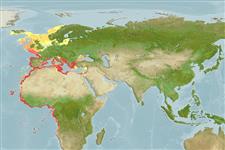
marino batidemersal; rango de profundidad 60 - 1309 m (Ref. 128029). Deep-water; 70°N - 17°S, 25°W - 36°E (Ref. 54693)
Eastern Atlantic: Bay of Biscay and Mediterranean Sea to Senegal, north to Cornwall, England (apparently as a stray). Compagno et al. (Ref. 5578) reports this species as ranging south to Cape Point, South Africa but Springer 1990 (Ref. 10718) notes Bass et al. 1976 as considering specimens from Walvis Bay distinct from Oxynotus centrina calling attention to the considerably greater distance between dorsal fins in Mediterranean specimens than in specimens taken south of the equator.
Longitud en la primera madurez / Tamaño / Peso / Edad
Madurez: Lm ?, range 50 - ? cm
Max length : 150 cm TL macho / no sexado; (Ref. 247); common length : 55.0 cm TL macho / no sexado; (Ref. 26999)
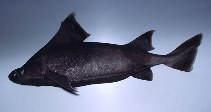
Espinas dorsales (total) : 2; Espinas anales: 0. A small bizarre-looking shark with an unmistakable high body and bristly textured skin (Ref. 5578). Uniformly grey to grey-brown (Ref. 5578).
Body shape (shape guide): elongated.
Found on the outer continental shelf and upper slope (Ref. 5578). Depth range from 60-660 m (Ref. 247) and from 549-777 m in the eastern Ionian Sea (Ref. 56504), and 818-1309 m NW Africa (Ref. 128029). Feeds on polychaetes (Ref. 247) and sipunculids (apparenly a suction feeder which mainly feeds on worm-like prey), which are rapidly digested, and the rapid gastric evacuation could partially explain the vacuity of several guts; teleosts, crustaceans and echinoderms are considered as accessory prey items, thus recorded predation on egg cases of the smallspotted catshark Scyliorhinus canicula remains an occasional phenomenon (Ref. 81816). Ovoviviparous (Ref. 205). Utilized for fishmeal, oil, and smoked and dried salted for human consumption (Ref. 247).
Ciclo vital y comportamiento de apareamiento
Madurez | Reproducción | Puesta | Huevos | Fecundidad | Larva
Ovoviviparous, without a placenta, with about 7 or 8 young in a litter (Ref. 247). Distinct pairing with embrace (Ref. 205).
Compagno, L.J.V., 1984. FAO Species Catalogue. Vol. 4. Sharks of the world. An annotated and illustrated catalogue of shark species known to date. Part 1 - Hexanchiformes to Lamniformes. FAO Fish. Synop. 125(4/1):1-249. Rome, FAO. (Ref. 247)
Situación en la Lista Roja de la UICN (Ref. 130435: Version 2025-2 (Global))
Amenaza para el ser humano
Harmless
Usos humanos
Pesquerías: escaso valor comercial
Herramientas
Informes especiales
Descargar XML
Fuentes de Internet
Estimaciones basadas en modelos
Temperatura preferida (Referencia
123201): 9.5 - 15.3, mean 13.3 °C (based on 283 cells).
Índice de diversidad filogenética (Referencia
82804): PD
50 = 0.5625 [Uniqueness, from 0.5 = low to 2.0 = high].
Bayesian length-weight: a=0.00363 (0.00158 - 0.00837), b=3.15 (2.94 - 3.36), in cm total length, based on LWR estimates for this (Sub)family-body shape (Ref.
93245).
Nivel trófico (Referencia
69278): 3.1 ±0.3 se; based on diet studies.
Resiliencia (Referencia
120179): Muy bajo, población duplicada en un tiempo mínimo superior a 14 años (Fec=7).
Vulnerabilidad pesquera (Ref.
59153): Very high vulnerability (90 of 100).
🛈
Vulnerabilidad climática (Ref.
125649): Moderate vulnerability (38 of 100).
🛈
Nutrientes (Ref.
124155): Calcium = 5.91 [1.03, 31.36] mg/100g; Iron = 0.271 [0.065, 0.929] mg/100g; Protein = 18.7 [16.8, 20.5] %; Omega3 = 0.229 [0.074, 0.746] g/100g; Selenium = 18.8 [5.3, 65.9] μg/100g; VitaminA = 5.9 [1.1, 30.1] μg/100g; Zinc = 0.392 [0.185, 0.747] mg/100g (wet weight);