Elasmobranchii (haaien en roggen) (sharks and rays) >
Pristiophoriformes (Saw sharks) >
Pristiophoridae (Saw sharks)
Etymology: Pristiophorus: pristio-, presumably derived from prio (Gr.), to saw, but treated here as a noun (a saw); phorus, from phoreus (Gr.), bearer or carrier, referring to saw-like snout (note also that pristis is Greek for sawfish) (See ETYFish); cirratus: Latin for curly or fringed, referring to long, string-like ventral barbels (See ETYFish).
Milieu: milieu / Klimaatzone / Diepte / verspreidingsgebied
Ecologie
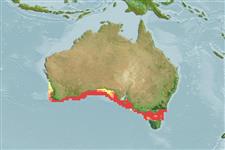
marien demersaal; diepte 37 - 310 m (Ref. 6871), usually 37 - 146 m (Ref. 54709). Subtropical; 28°S - 45°S, 113°E - 154°E (Ref. 54709)
Eastern Indian Ocean: southern Australia (Ref. 6871). Does not occur in the Western Central Pacific (Ref. 31368).
Lengte bij maturiteit / Grootte / Gewicht / Leeftijd
Maturiteit: Lm ?, range 97 - ? cm
Max length : 137 cm TL mannelijk / geslacht onbekend; (Ref. 247); common length : 125 cm TL mannelijk / geslacht onbekend; (Ref. 9987); max. gerapporteerde leeftijd: 15 Jaren (Ref. 6871)
Korte beschrijving
Determinatiesleutels | Morfologie | Morfometrie
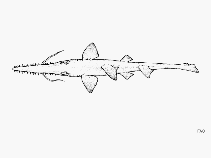
Pristiophorus cirratus has a long, narrow, and narrowly tapering rostrum (rostrum length is 27-29% of TL), distance from rostral tip to barbels about equal or slightly greater than distance from barbels to mouth (1:1.2-1.3); distance from rostral barbels to nostrils slightly less or equal to distance from nostrils to 1st to 4th gill slits. About 9-10 large rostral teeth on each side of the rostrum in front of the barbels, 9 behind them; distance from mouth to nostrils 1.3-1.4 times internarial space. Tooth rows 39-49 in upper jaw. Dorsal and pectoral fins covered with denticles in large specimens. Lateral trunk denticles largely unicuspidate. First dorsal fin origin behind free rear tips of pectorals by eye length or more (Ref. 247).
P. cirratus has a body pattern of dark blotches (mostly darker bands between pectoral fin bases, over gill slits, between spiracles and below dorsal fins) and spots (occasionally faint). Nostrils, almost circular, are situated about 2/3 way from barbels to corner or mouth, width at nostrils more than 4.5 in preoral snout in adults; preoral snout length more than 2.3 times distance from barbels to snout tip (Ref. 6871). Rostral teeth with dark margins; underside abruptly uniformly white (Ref. 41394). First dorsal fin origin behind free rear tips of pectorals by eye length or more (Ref. 247). Caudal fin almost straight, with slender upper and lower lobes; pectoral well developed but are not ray-like (Ref. 6871).
Body shape (shape guide): elongated.
Found on the continental shelf and upper slope. Forms schools. Feeds on small fishes, including cornet fishes (Fistularia), and crustaceans. Ovoviviparous, with 3-22 young in a litter (48360). Size at birth about 31-34 cm. May live for more than 15 years. Meat marketed fresh and frozen.
Ovoviviparous, embryos feed solely on yolk (Ref. 50449). Males mature at about 97 cm, born at about 38 cm (Ref. 6871). Common sawshark lives for more than 15 years. Mature females appear to breed every 1-2 years, carrying from 3-22 young, with about 10 being the average. After 12 months' gestation, the pups are born in shallow coastal areas. They are about 11-14.5 in (27-37 cm) long at birth (Ref. 48640).
Compagno, L.J.V., 1984. FAO Species Catalogue. Vol. 4. Sharks of the world. An annotated and illustrated catalogue of shark species known to date. Part 1 - Hexanchiformes to Lamniformes. FAO Fish. Synop. 125(4/1):1-249. Rome, FAO. (Ref. 247)
Status op de Rode Lijst van het IUCN (Ref. 130435: Version 2025-2 (Global))
Gevaar voor de mens
Harmless
Gebruik door de mens
Visserij: commercieel
Tools
Speciale rapporten
Download XML
Internetbronnen
Schattingen op basis van modellen
Gewenste temperatuur (Ref.
123201): 14 - 17.7, mean 15.4 °C (based on 112 cells).
Fylogenetische diversiteitsindex (Ref.
82804): PD
50 = 0.5098 [Uniqueness, from 0.5 = low to 2.0 = high].
Bayesian length-weight: a=0.00389 (0.00180 - 0.00842), b=3.12 (2.94 - 3.30), in cm total length, based on all LWR estimates for this body shape (Ref.
93245).
Trofisch niveau (Ref.
69278): 4.2 ±0.71 se; based on food items.
Weerstandsvermogen (Ref.
120179): laag, minimale populatieverdubbelingstijd 4,5-14 jaar (tmax=15; Fec=3).
Kwetsbaarheid van de visserij (Ref.
59153): Very high vulnerability (82 of 100).
🛈