>
Gobiiformes (Gobies) >
Gobiidae (Gobies) > Gobiinae
Etymology: Amblyeleotris: Greek, amblys = darkness + The name of a Nile fish, eleotris (Ref. 45335).
More on author: Bleeker.
Umwelt: Milieu / Klimazone / Tiefenbereich / Verbreitungsgebiet
Ökologie
seewasser riff-verbunden; tiefenbereich 5 - 35 m (Ref. 48637), usually 10 - 20 m (Ref. 27115). Tropical; 22°C - 28°C (Ref. 27115); 35°N - 23°S, 32°E - 174°W
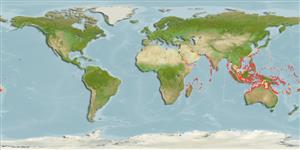
Indo-West Pacific: Persian Gulf (Ref.80050) and Red Sea to Tonga, north to Japan and south to Australia.
Größe / Gewicht / Alter
Geschlechtsreife: Lm ? range ? - ? cm
Max length : 11.0 cm SL Männchen/unbestimmt; (Ref. 48637)
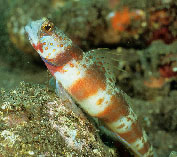
Rückenflossenstacheln (insgesamt) : 7; Rückenflossenweichstrahlen (insgesamt) : 12; Afterflossenstacheln: 1; Afterflossenweichstrahlen: 12. Characterized by whitish body color; head and side with six brown to reddish bars and irregular brown blotches in pale spaces in between; four branched main body bars on lower side; red blotch on lower cheek just behind mouth; red or orange spots on head, dark-edged; separate pelvic fins, joined by low membrane at base of fins; without median predorsal scales or only few embedded scales just in front of first dorsal fin; longitudinal scale series 80-85; greatest depth of body 4.6-6.4 in SL; caudal fin longer than head, 2.8-3.4 in SL (Ref. 90102).
Body shape (shape guide): elongated; Cross section: circular.
Inhabits coastal to outer reef sand slopes to 35 meters depth (Ref. 48637); on sandy areas of lagoon and seaward reefs (Ref. 9710). Inhabits burrows with alpheid shrimps (Ref. 11441).
Lebenszyklus und Paarungsverhalten
Geschlechtsreife | Fortpflanzung | Ablaichen | Eier | Fruchtbarkeit | Larven
Myers, R.F., 1991. Micronesian reef fishes. Second Ed. Coral Graphics, Barrigada, Guam. 298 p. (Ref. 1602)
IUCN Rote Liste Status (Ref. 130435: Version 2025-2 (Global))
Bedrohung für Menschen
Harmless
Nutzung durch Menschen
Fischereien: kommerziell; Aquarium: Kommerziell
Tools
Zusatzinformationen
Download XML
Internet Quellen
Schätzungen auf der Grundlage von Modellen
Bevorzugte Temperatur (Ref.
123201): 25.2 - 29.1, mean 28 °C (based on 484 cells).
Phylogenetischer Diversitätsindex (Ref.
82804): PD
50 = 0.5000 [Uniqueness, from 0.5 = low to 2.0 = high].
Bayesian length-weight: a=0.00741 (0.00347 - 0.01582), b=3.09 (2.91 - 3.27), in cm total length, based on LWR estimates for this (Sub)family-body shape (Ref.
93245).
Trophische Ebene (Ref.
69278): 3.4 ±0.4 se; based on size and trophs of closest relatives
Widerstandsfähigkeit (Ref.
120179): hoch, Verdopplung der Population dauert weniger als 15 Monate. (Preliminary K or Fecundity.).
Anfälligkeit der Fischerei (Ref.
59153): Low vulnerability (10 of 100).
🛈
Nährstoffe (Ref.
124155): Calcium = 122 [55, 228] mg/100g; Iron = 0.714 [0.369, 1.368] mg/100g; Protein = 17.9 [15.9, 19.6] %; Omega3 = 0.0936 [, ] g/100g; Selenium = 25.3 [12.0, 54.9] μg/100g; VitaminA = 132 [35, 453] μg/100g; Zinc = 1.92 [1.25, 2.84] mg/100g (wet weight);