>
Gobiiformes (Gobies) >
Gobiidae (Gobies) > Gobiinae
Eponymy: Charlotte ‘Lotte’ Hildregard Hass née Baierl (1928–2015) was an Austrian diver, model and actress. [...] (Ref. 128868), visit book page.
Environnement : milieu / zone climatique / profondeur / gamme de distribution
Écologie
marin récifal; profondeur 10 - 15 m (Ref. 90832). Tropical; 22°C - 26°C (Ref. 27115); 30°N - 18°S
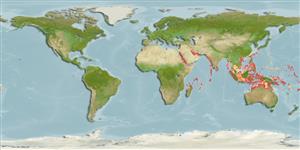
Western Indian Ocean: Red Sea and adjacent areas. Elsewhere in the Indo-West Pacific refers to Lotilia klausewitzi.
Taille / Poids / Âge
Maturité: Lm ? range ? - ? cm
Max length : 3.1 cm SL mâle / non sexé; (Ref. 90832)
Description synthétique
Clés d'identification | Morphologie | Morphométrie
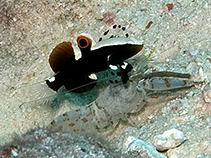
Épines dorsales (Total) : 7; Rayons mous dorsaux (Total) : 9; Épines anales: 1 - 9; Rayons mous anaux: 9; Vertèbres: 26. This species is distinguished by the following characters: no cephalic sensory canals and pores; sensory-papillae row 4i not extending ventrally beyond a horizontal line through posterior end of row d; right and left sides of row n are not close to one another, with a broad interspace between them; branched caudal-fin rays 7+7=14; pale area on dorsum from snout to dorsoanterior part of body is relatively long, extending posteriorly to around base of third or fourth spine; presence of a conspicuous ocellated black spot with vivid pale margin at center of first dorsal fin, extending anteriorly beyond third spine; absence of a submarginal row of black spots on caudal fin (Ref. 90832).
Cross section: compressed.
Found only on sandy areas, and symbiotically associates with a snapping shrimp, probably Alpheus djiboutensis where it swims freely at ca. 10-15 cm above the nest hole as it moves its pectoral fins alternately. It was also reported that, in the northern Red Sea, it is associated with an unidentified Alpheus species which is not A. djiboutensis (Ref. 90832).
Cycle de vie et comportement reproducteur
Maturité | Reproduction | Frai | Œufs | Fécondité | Larves
Shibukawa, K., T. Suzuki and H. Senou, 2012. Review of the shrimp-associated goby genus Lotilia (Actinopterygii: Perciformes: Gobiidae), with description of a new species from the West Pacific. Zootaxa 3362:54-64. (Ref. 90832)
Statut dans la liste rouge de l'IUCN (Ref. 130435: Version 2025-2 (Global))
Menace pour l'homme
Harmless
Utilisations par l'homme
Pêcheries: commercial; Aquarium: Commercial
Outils
Articles particuliers
Télécharger en XML
Sources Internet
Estimations basées sur des modèles
Température préférée (Réf.
123201): 25.3 - 29.1, mean 28.1 °C (based on 488 cells).
Indice de diversité phylogénétique (Réf.
82804): PD
50 = 0.7500 [Uniqueness, from 0.5 = low to 2.0 = high].
Bayesian length-weight: a=0.00741 (0.00347 - 0.01582), b=3.09 (2.91 - 3.27), in cm total length, based on LWR estimates for this (Sub)family-body shape (Ref.
93245).
Niveau trophique (Réf.
69278): 3.1 ±0.3 se; based on size and trophs of closest relatives
Résilience (Réf.
120179): Haut, temps minimum de doublement de population inférieur à 15 mois (Preliminary K or Fecundity.).
Vulnérabilité de la pêche (Ref.
59153): Low vulnerability (10 of 100).
🛈
Nutriments (Ref.
124155): Calcium = 238 [101, 517] mg/100g; Iron = 1.04 [0.49, 2.11] mg/100g; Protein = 17.7 [15.7, 19.5] %; Omega3 = 0.106 [0.042, 0.228] g/100g; Selenium = 27.4 [10.9, 69.2] μg/100g; VitaminA = 147 [37, 574] μg/100g; Zinc = 2.86 [1.75, 4.42] mg/100g (wet weight);