>
Gobiiformes (Gobies) >
Gobiidae (Gobies) > Gobiinae
Etymology: Amblygobius: Greek, amblys = darkness + Latin gobius = gudgeon (Ref. 45335).
More on author: Herre.
Umwelt: Milieu / Klimazone / Tiefenbereich / Verbreitungsgebiet
Ökologie
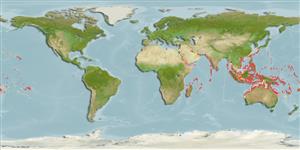
seewasser riff-verbunden; standorttreu (Ref. 52884); tiefenbereich 1 - 30 m (Ref. 86942). Tropical; 35°N - 28°S, 32°E - 143°W
Western Indian Ocean: Maldives (Ref. 30829) and the Red Sea and Arabian Gulf (Ref. 11441). Pacific Ocean: Philippines to the Tuamoto Islands, north to Yaeyama Islands, south to Rowley Shoals, southern Great Barrier Reef and Rapa; Guam and Kapingamarangi in Micronesia.
Größe / Gewicht / Alter
Geschlechtsreife: Lm ? range ? - ? cm
Max length : 10.0 cm SL Männchen/unbestimmt; (Ref. 48637)
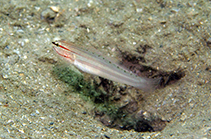
Rückenflossenstacheln (insgesamt) : 7; Rückenflossenweichstrahlen (insgesamt) : 13 - 15; Afterflossenstacheln: 1; Afterflossenweichstrahlen: 13 - 15. Characterized by having overall pale grey body color; head and body with pink stripes, most intense on head; dorsal fin base with row of 8-9 dark spots; first and second dorsal fin equal in height; slightly pointed caudal fin; longitudinal scale series 63-66; cycloid scales; head without scales; depth of body 4.7-6.4 in SL (Ref. 90102).
Body shape (shape guide): fusiform / normal; Cross section: oval.
Adults are solitary or in pairs (Ref. 90102). They are ommon in areas with fine sand to muddy bottoms at the bases of inner lagoon and coastal reefs. Monogamous (Ref. 52884, 48637). Feed on small invertebrates and organic matter (Ref. 89972).
Lebenszyklus und Paarungsverhalten
Geschlechtsreife | Fortpflanzung | Ablaichen | Eier | Fruchtbarkeit | Larven
Monogamous mating is observed as both obigate and social (Ref. 52884).
Myers, R.F., 1991. Micronesian reef fishes. Second Ed. Coral Graphics, Barrigada, Guam. 298 p. (Ref. 1602)
IUCN Rote Liste Status (Ref. 130435: Version 2025-2 (Global))
Bedrohung für Menschen
Harmless
Nutzung durch Menschen
Fischereien: kommerziell; Aquarium: Kommerziell
Tools
Zusatzinformationen
Download XML
Internet Quellen
Schätzungen auf der Grundlage von Modellen
Bevorzugte Temperatur (Ref.
123201): 25.1 - 29.3, mean 28.3 °C (based on 2853 cells).
Phylogenetischer Diversitätsindex (Ref.
82804): PD
50 = 0.5000 [Uniqueness, from 0.5 = low to 2.0 = high].
Bayesian length-weight: a=0.01023 (0.00477 - 0.02194), b=3.01 (2.83 - 3.19), in cm total length, based on LWR estimates for this (Sub)family-body shape (Ref.
93245).
Trophische Ebene (Ref.
69278): 3.0 ±0.2 se; based on size and trophs of closest relatives
Widerstandsfähigkeit (Ref.
120179): hoch, Verdopplung der Population dauert weniger als 15 Monate. (Preliminary K or Fecundity.).
Anfälligkeit der Fischerei (Ref.
59153): Low vulnerability (10 of 100).
🛈
Nährstoffe (Ref.
124155): Calcium = 107 [58, 217] mg/100g; Iron = 0.762 [0.398, 1.384] mg/100g; Protein = 18.6 [16.7, 20.3] %; Omega3 = 0.159 [0.072, 0.276] g/100g; Selenium = 21 [11, 41] μg/100g; VitaminA = 153 [44, 470] μg/100g; Zinc = 1.74 [1.18, 2.57] mg/100g (wet weight);