>
Gobiiformes (Gobies) >
Gobiidae (Gobies) > Gobiinae
Etymology: Eviota: No etymology given, suggested by Christopher Scharpt: from Latin 'eu' for 'true' and 'iota' for anything very small, in combination 'truly very small' referring to it as being the smallest vertebrate at the time it has benn described by Jenkins (thus, making the suggestion by Scharpt plausible.
More on authors: Jewett & Lachner.
Environnement : milieu / zone climatique / profondeur / gamme de distribution
Écologie
marin récifal; profondeur 3 - 20 m (Ref. 90102). Tropical
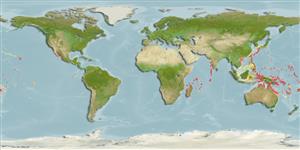
Indo-West Pacific: Seychelles to Indonesia, north to Japan (Ogasawara Islands); east to Micronesia and Melanesia to Wallis and Futuna; south to Australia (Western Australia and Great Barrier Reef). The species in the Philippines, Fiji and Tonga is considered E. cf. sigillata.
Longueur à la première maturité / Taille / Poids / Âge
Maturité: Lm 1.3, range 1 - 2 cm
Max length : 3.0 cm SL mâle / non sexé; (Ref. 48637); âge max. reporté: 0.16 années (Ref. 58013)
Description synthétique
Clés d'identification | Morphologie | Morphométrie
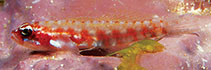
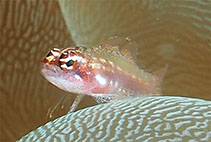
Épines dorsales (Total) : 7; Rayons mous dorsaux (Total) : 8 - 10; Épines anales: 1; Rayons mous anaux: 7 - 8. Characterized by semi-translucent body with irregular, internal reddish midlateral stripe; white stripe along spinal column interrupted by reddish bars that extend ventrally; row of small reddish spots along dorsal midline; usually with narrow reddish bars above anal fin; often prolonged and filamentous first four dorsal spines of male and first three of female; unbranched pectoral rays; longitudinal scale series 21-24; ctenoid scales, absent on head , nape and pectoral fin base; depth of body 4.3-5.0 in SL (Ref. 90102).
Body shape (shape guide): elongated; Cross section: compressed.
Adults live for 59 days at the most, with larvae spending three weeks in the open ocean and maturing within two weeks of settling on a reef, leaving the adults (which are 1 to 2 centimeters long) just three weeks to reproduce. This strategy of 'live fast, die young' is perceived to be a response to intense predation. Daily mortality rate, from tag-recapture data, might be as high as 8% (Ref. 54199). Occur at depths less than 4 to between 17 and 21 m on sandy bottoms of lagoon reefs (Ref. 1602, 37816, 48637). Minimum depth from Ref. 58018. Spawning appears to be repeated on a regular cycle, semilunar or every 14 days (Ref. 116739).
Myers, R.F., 1991. Micronesian reef fishes. Second Ed. Coral Graphics, Barrigada, Guam. 298 p. (Ref. 1602)
Statut dans la liste rouge de l'IUCN (Ref. 130435: Version 2025-2 (Global))
Menace pour l'homme
Harmless
Utilisations par l'homme
Outils
Articles particuliers
Télécharger en XML
Sources Internet
Estimations basées sur des modèles
Température préférée (Réf.
123201): 24.7 - 29.3, mean 28.1 °C (based on 1837 cells).
Indice de diversité phylogénétique (Réf.
82804): PD
50 = 0.5000 [Uniqueness, from 0.5 = low to 2.0 = high].
Bayesian length-weight: a=0.00692 (0.00281 - 0.01706), b=3.09 (2.92 - 3.26), in cm total length, based on LWR estimates for this Genus-body shape (Ref.
93245).
Niveau trophique (Réf.
69278): 3.1 ±0.3 se; based on size and trophs of closest relatives
Generation time: 0.1 ( na - na) years. Estimated as median ln(3)/K based on 1
growth studies.
Résilience (Réf.
120179): Haut, temps minimum de doublement de population inférieur à 15 mois (tmax=0.16; Fec = 400 (lifetime)).
Vulnérabilité de la pêche (Ref.
59153): Low vulnerability (10 of 100).
🛈
Nutriments (Ref.
124155): Calcium = 3390 [88, 549,132] mg/100g; Iron = 38.8 [1.2, 783.6] mg/100g; Protein = 16.9 [10.7, 23.2] %; Omega3 = 0.0501 [, ] g/100g; Selenium = 2830 [6, 995,074] μg/100g; VitaminA = 0.262 [0.000, 369.350] μg/100g; Zinc = 105 [5, 1,034] mg/100g (wet weight);