Elasmobranchii (tubarões e raias) (sharks and rays) >
Squatiniformes (Angel sharks) >
Squatinidae (Angel sharks)
Etymology: Squatina: Latin for skate, which angel sharks superficially resemble, presumably tautonymous with Squalus squatina Linnaeus 1758 (no species mentioned) (See ETYFish); australis: Latin for southern, referring to distribution along coast of southern Australia (See ETYFish).
More on author: Regan.
Ambiente: milieu / zona climática / intervalo de profundidade / gama de distribuição
Ecologia
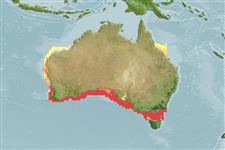
marinhas demersal; intervalo de profundidade 15 - 256 m (Ref. 54902). Temperate; 18°S - 44°S, 113°E - 153°E (Ref. 54902)
Eastern Indian Ocean: southern Australia (including New South Wales).
Tamanho / Peso / Idade
Maturidade: Lm ? range ? - ? cm
Max length : 152 cm TL macho/indeterminado; (Ref. 247)
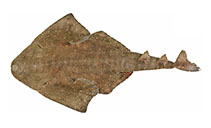
Espinhos dorsais (total) : 0; Espinhos anais: 0. Numerous dark spots on lower lobe of caudal fin (Ref. 31369). Pectoral fins greatly enlarged, with broad triangular lobe extending forward from their bases on either side of the gill slits; pelvic fins enlarged and wing-like; caudal very short, nearly symmetrical but not lunate, its lower lobe slightly longer than the upper (Ref. 31369).
Body shape (shape guide): other.
A common but little-known angelshark found on the continental shelf and uppermost slope, on or near the bottom (Ref. 247, 75154). Occurs from close inshore to 130 m depth (Ref. 31369, 6871). Feeds mainly on small fishes and crustaceans (Ref. 6871). Ovoviviparous (Ref. 247). Flesh is highly esteemed (Ref. 6871).
Ciclo de vida e comportamento de acasalamento
Maturidade | Reprodução | Desova | Ovos | Fecundidade | Larvas
Ovoviviparous, embryos feed solely on yolk (Ref. 50449).
Compagno, L.J.V., 1984. FAO Species Catalogue. Vol. 4. Sharks of the world. An annotated and illustrated catalogue of shark species known to date. Part 1 - Hexanchiformes to Lamniformes. FAO Fish. Synop. 125(4/1):1-249. Rome, FAO. (Ref. 247)
Categoria na Lista Vermelha da IUCN (Ref. 130435: Version 2025-2 (Global))
Ameaça para o homem
Traumatogenic
Utilização humana
Pescarias: pouco comercial
Ferramentas
Relatórios especiais
Descarregue XML
Fontes da internet
Estimativas baseadas em modelos
Temperatura preferida (Ref.
123201): 14 - 20.4, mean 16 °C (based on 129 cells).
Índice de diversidade filogenética (Ref.
82804): PD
50 = 0.5000 [Uniqueness, from 0.5 = low to 2.0 = high].
Bayesian length-weight: a=0.00661 (0.00287 - 0.01523), b=3.07 (2.88 - 3.26), in cm total length, based on LWR estimates for this Genus-body shape (Ref.
93245).
Nível Trófico (Ref.
69278): 4.0 ±0.66 se; based on food items.
Resiliência (Ref.
120179): Baixo, tempo mínimo de duplicação da população 4,5 - 14 anos (Fec assumed to be <100).
Vulnerabilidade da pesca (Ref.
59153): Very high vulnerability (90 of 100).
🛈