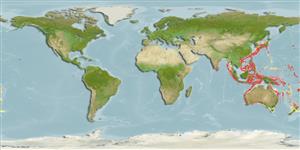
Umwelt: Milieu / Klimazone / Tiefenbereich / Verbreitungsgebiet
Ökologie
seewasser bathydemersal; tiefenbereich 140 - 600 m (Ref. 44036). Deep-water
Western Pacific: southern Japan. More recent works report of its occurrence in Taiwan (Ref. 5193), Malaysia (Ref. 5756) and the Chesterfield Islands (Ref. 11897).
Größe / Gewicht / Alter
Geschlechtsreife: Lm ? range ? - ? cm
Max length : 95.0 cm SL Männchen/unbestimmt; (Ref. 559); common length : 35.0 cm NG Männchen/unbestimmt; (Ref. 27550)
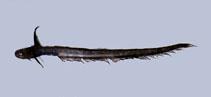
Rückenflossenstacheln (insgesamt) : 0; Rückenflossenweichstrahlen (insgesamt) : 8 - 10; Afterflossenstacheln: 0. Longest ray of pelvic fin thin, long reaching to or near tip of pectoral fin. Lip of upper jaw thin. Upper jaw with a short band of villiform teeth; lower jaw, palatine, pre vomer and tongue toothless. Body purplish-brown, semi-transparent. Attain 95 cm SL.
Body shape (shape guide): elongated; Cross section: circular.
Feeds on prawns (Ref. 27550).
Lebenszyklus und Paarungsverhalten
Geschlechtsreife | Fortpflanzung | Ablaichen | Eier | Fruchtbarkeit | Larven
Masuda, H., K. Amaoka, C. Araga, T. Uyeno and T. Yoshino, 1984. The fishes of the Japanese Archipelago. Vol. 1. Tokai University Press, Tokyo, Japan. 437 p. (text). (Ref. 559)
IUCN Rote Liste Status (Ref. 130435: Version 2025-2 (Global))
Bedrohung für Menschen
Harmless
Nutzung durch Menschen
Fischereien: nicht kommerziell
Tools
Zusatzinformationen
Download XML
Internet Quellen
Schätzungen auf der Grundlage von Modellen
Bevorzugte Temperatur (Ref.
123201): 8.1 - 18.9, mean 13.1 °C (based on 271 cells).
Phylogenetischer Diversitätsindex (Ref.
82804): PD
50 = 0.5314 [Uniqueness, from 0.5 = low to 2.0 = high].
Bayesian length-weight: a=0.00389 (0.00180 - 0.00842), b=3.12 (2.94 - 3.30), in cm total length, based on all LWR estimates for this body shape (Ref.
93245).
Trophische Ebene (Ref.
69278): 4.2 ±0.73 se; based on food items.
Anfälligkeit der Fischerei (Ref.
59153): High to very high vulnerability (70 of 100).
🛈