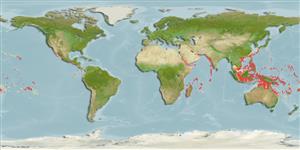
Umwelt: Milieu / Klimazone / Tiefenbereich / Verbreitungsgebiet
Ökologie
seewasser riff-verbunden; tiefenbereich 15 - 53 m (Ref. 11441). Tropical
Indo-Pacific: Known from the Society Islands, Hawaiian Islands, Palau (Myers, 1999), Solomon Islands, Great Barrier Reef, Ryukyu Islands (Senou et al., 2004), Gulf of Thailand, Indonesia (Randall, 2005), Chagos Archipelago, Maldive Islands (Kuiter, 1998), and Oman (Randall, 1995). Reported as a first record for the Red Sea from an underwater photograph taken by Sven Kahlbrock off Hurghada, Egypt (Ref. 89154). Maldives (Ref. 30829) and Chagos Archipelago to the Hawaiian Islands.
Größe / Gewicht / Alter
Geschlechtsreife: Lm ? range ? - ? cm
Max length : 2.5 cm SL Männchen/unbestimmt; (Ref. 59154)
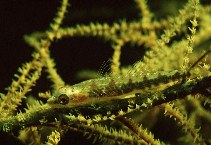
Rückenflossenstacheln (insgesamt) : 6 - 7; Rückenflossenweichstrahlen (insgesamt) : 7; Afterflossenstacheln: 1; Afterflossenweichstrahlen: 8 - 9. Dorsal-fin rays VI + I,7 or I,8 (usually I,8); anal-fin rays usually I,8 or I,9; pectoral-fin rays 12–14 (usually 13); anteriormost scales on body usually reaching to above or a little anterior to pectoral-fin base, the longitudinal scale series 32–59 (mean scale count 47); body elongate, the depth at origin of anal fin 11.6–14.5 % SL; head width about equal to head depth; snout length about equal to orbit diameter; gill opening small, reaching ventrally to below or just anterior to lower edge of pectoral-fin base; mouth slightly inferior; a recurved canine tooth (or pair of teeth) at side of lower jaw; lower edge of preopercle slightly scalloped; caudal fin truncate with rounded corners; pelvic fins short, round, and cup-like, the pelvic spines and frenum thickened; dorsal two-fifths of body transparent, crossed by six or seven narrow bars that may be yellow, dusky orange, or red, with a small spot of the same color dorsally between each bar; a white line above vertebral column; lower three-fifths of body dusky to blackish orange. Largest specimen, 24.5 mm (Ref. 89154).
Body shape (shape guide): elongated; Cross section: compressed.
Inhabit deep slopes, subject to strong currents, with isolated outcrops of black corals (Ref. 48637). Benthic (Ref. 58302). Found in small groups. Eggs are laid on a branch section after removing the polyps and guarded by the male (Ref. 48637). Associated with antipatharian corals at depths below 15 m (Ref. 2334). Dart out to feed on small animals of the plankton (Ref. 11441).
Lebenszyklus und Paarungsverhalten
Geschlechtsreife | Fortpflanzung | Ablaichen | Eier | Fruchtbarkeit | Larven
Randall, J.E., G.R. Allen and R.C. Steene, 1990. Fishes of the Great Barrier Reef and Coral Sea. University of Hawaii Press, Honolulu, Hawaii. 506 p. (Ref. 2334)
IUCN Rote Liste Status (Ref. 130435: Version 2025-2 (Global))
Bedrohung für Menschen
Harmless
Nutzung durch Menschen
Fischereien: kommerziell; Aquarium: Kommerziell
Tools
Zusatzinformationen
Download XML
Internet Quellen
Schätzungen auf der Grundlage von Modellen
Bevorzugte Temperatur (Ref.
123201): 24.7 - 28.9, mean 27.7 °C (based on 430 cells).
Phylogenetischer Diversitätsindex (Ref.
82804): PD
50 = 0.5000 [Uniqueness, from 0.5 = low to 2.0 = high].
Bayesian length-weight: a=0.00741 (0.00347 - 0.01582), b=3.09 (2.91 - 3.27), in cm total length, based on LWR estimates for this (Sub)family-body shape (Ref.
93245).
Trophische Ebene (Ref.
69278): 3.4 ±0.45 se; based on food items.
Widerstandsfähigkeit (Ref.
120179): hoch, Verdopplung der Population dauert weniger als 15 Monate. (Preliminary K or Fecundity.).
Anfälligkeit der Fischerei (Ref.
59153): Low vulnerability (10 of 100).
🛈