>
Anguilliformes (Eels and morays) >
Ophichthidae (Snake eels) > Myrophinae
Etymology: Scolecenchelys: Greek, skolex = worm (1855) + Greek, enchlys, -yos = eel (Ref. 45335).
More on author: Bleeker.
Umwelt: Milieu / Klimazone / Tiefenbereich / Verbreitungsgebiet
Ökologie
seewasser riff-verbunden; tiefenbereich 0 - 30 m (Ref. 86942). Tropical; 32°N - 28°S
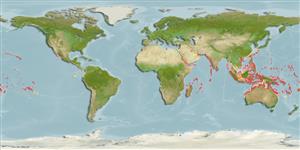
Indo-Pacific: widespread, from East Africa to Samoa, north to Okinawa-jima Island, Japan, excluding the Red Sea and the coast of Australia.
Größe / Gewicht / Alter
Geschlechtsreife: Lm ? range ? - ? cm
Max length : 38.0 cm TL Männchen/unbestimmt; (Ref. 1602)
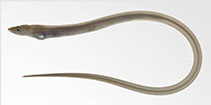
Wirbelzahl: 118 - 135. This species is distinguished by the following set of characters: 2 infraorbital pores found at the postorbital area; median ventral groove on the snout absent; acute snout; rictus of mouth slightly posterior to a vertical line through the posterior margin of the eye; pointed conical teeth on upper jaw and vomer, arranged biserially on upper jaw, uniserially on vomer; dorsal-fin origin posterior to a vertical line through the anus, horizontal distance between the origin and the vertical line 13-55% HL; tail 54-58% TL; total vertebrae 118-135, predorsal 51-57 and preanal 47-52; mean vertebral formula (MVF) 53.9-50.0-128.6 (Ref. 92899).
Body shape (shape guide): eel-like; Cross section: circular.
Lives in loose sand and fine gravel (Ref. 1602). Benthic (Ref. 58302) and burrowing species found in inshore waters (Ref. 7300, 75154). Feeds on small fishes and crustaceans (Ref. 89972).
Lebenszyklus und Paarungsverhalten
Geschlechtsreife | Fortpflanzung | Ablaichen | Eier | Fruchtbarkeit | Larven
Hibino, Y. and S. Kimura, 2015. Revision of the Scolecenchelys gymnota species group with descriptions of two new species (Anguilliformes: Ophichthidae: Myrophinae). Ichthyol Res (Ref. 104540)
IUCN Rote Liste Status (Ref. 130435: Version 2025-2 (Global))
Bedrohung für Menschen
Harmless
Nutzung durch Menschen
Tools
Zusatzinformationen
Download XML
Internet Quellen
Schätzungen auf der Grundlage von Modellen
Bevorzugte Temperatur (Ref.
123201): 24.9 - 29.2, mean 28.1 °C (based on 2563 cells).
Phylogenetischer Diversitätsindex (Ref.
82804): PD
50 = 0.5000 [Uniqueness, from 0.5 = low to 2.0 = high].
Bayesian length-weight: a=0.00076 (0.00029 - 0.00201), b=3.06 (2.83 - 3.29), in cm total length, based on LWR estimates for this (Sub)family-body shape (Ref.
93245).
Trophische Ebene (Ref.
69278): 4.1 ±0.7 se; based on size and trophs of closest relatives
Widerstandsfähigkeit (Ref.
120179): hoch, Verdopplung der Population dauert weniger als 15 Monate. (Preliminary K or Fecundity.).
Anfälligkeit der Fischerei (Ref.
59153): Low to moderate vulnerability (28 of 100).
🛈
Nährstoffe (Ref.
124155): Calcium = 62.7 [35.8, 113.1] mg/100g; Iron = 0.628 [0.383, 1.195] mg/100g; Protein = 18.7 [16.4, 21.3] %; Omega3 = 0.116 [0.053, 0.326] g/100g; Selenium = 36.3 [20.4, 73.7] μg/100g; VitaminA = 64.2 [18.5, 196.7] μg/100g; Zinc = 1.2 [0.8, 1.7] mg/100g (wet weight);