Ambiente: milieu / zona climática / intervalo de profundidade / gama de distribuição
Ecologia
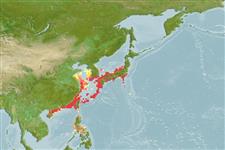
marinhas associadas(os) a recifes; intervalo de profundidade 10 - 50 m (Ref. 5222). Tropical; 39°N - 12°N, 110°E - 143°E (Ref. 5222)
Northwest Pacific: Korea, Japan, Taiwan, China, Viet Nam, and islands in the South China Sea.
Comprimento na primeira maturidade / Tamanho / Peso / Idade
Maturidade: Lm ?, range 16 - ? cm
Max length : 60.0 cm TL macho/indeterminado; (Ref. 5222); common length : 30.0 cm TL macho/indeterminado; (Ref. 9137)
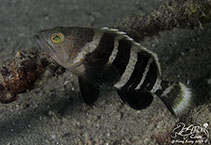
Espinhos dorsais (total) : 11; Raios dorsais moles (total) : 15 - 16; Espinhos anais: 3; Raios anais moles: 8. Distinguished by the following characteristics: head and body pale greyish brown dorsally, usually golden yellow ventrally; 4 broad dark bars on the dorsal part of the body, one on caudal peduncle and another often visible on nape; numerous small yellow spots on head and body; body and median fins with small greyish white spots; soft dorsal and caudal fins and sometimes the anal fin, with prominent yellow margin; dusky yellow paired fins; yellow mustache in the maxillary groove; body depth 2.7-3.3 times in SL; head length 2.3-2.6 times in SL; convex interorbital area; strongly convex dorsal head profile; subangular preopercle, 2-5 strong spines at the angle; upper edge of operculum straight, uppermost spine rudimentary; maxilla reaches about to vertical at rear edge of eye; 2 rows of small, subequal teeth on midlateral part of lower jaw; caudal fin convex; lateral body scales distinctly ctenoid, with auxiliary scales in fish larger than 30 cm SL; pyloric caeca 12, in 3 bundles (Ref. 089707).
Body shape (shape guide): fusiform / normal.
Occurs in rocky areas as well as on sandy-mud bottoms. Juveniles are common in tide pools. In captivity, the species is aggressive, chasing and biting other species, especially members of its own species. Protogynous hermaphrodite (Ref. 5222). Artificial fertilization of eggs was done and the longest survival time for the larvae was 15 days (Ref. 6780). In Hong Kong live fish markets (Ref. 27253).
Heemstra, P.C. and J.E. Randall, 1993. FAO Species Catalogue. Vol. 16. Groupers of the world (family Serranidae, subfamily Epinephelinae). An annotated and illustrated catalogue of the grouper, rockcod, hind, coral grouper and lyretail species known to date. Rome: FAO. FAO Fish. Synop. 125(16):382 p. (Ref. 5222)
Categoria na Lista Vermelha da IUCN (Ref. 130435: Version 2025-2 (Global))
Ameaça para o homem
Harmless
Utilização humana
Pescarias: espécies comerciais; Aquacultura: espécies comerciais
Ferramentas
Relatórios especiais
Descarregue XML
Fontes da internet
Estimativas baseadas em modelos
Temperatura preferida (Ref.
123201): 16.2 - 25.6, mean 22.5 °C (based on 74 cells).
Índice de diversidade filogenética (Ref.
82804): PD
50 = 0.5000 [Uniqueness, from 0.5 = low to 2.0 = high].
Bayesian length-weight: a=0.01096 (0.00635 - 0.01893), b=3.04 (2.90 - 3.18), in cm total length, based on LWR estimates for this species & Genus-body shape (Ref.
93245).
Nível Trófico (Ref.
69278): 3.6 ±0.55 se; based on food items.
Resiliência (Ref.
120179): Elevada, tempo mínimo de duplicação da população menor que 15 meses (Fecundity = 24,329).
Vulnerabilidade da pesca (Ref.
59153): Moderate vulnerability (44 of 100).
🛈
Nutrientes (Ref.
124155): Calcium = 25.4 [12.5, 56.5] mg/100g; Iron = 0.474 [0.258, 0.967] mg/100g; Protein = 18.4 [16.9, 19.8] %; Omega3 = 0.113 [0.070, 0.180] g/100g; Selenium = 34.9 [21.0, 62.3] μg/100g; VitaminA = 167 [47, 594] μg/100g; Zinc = 1.34 [0.94, 1.87] mg/100g (wet weight);