Ελασμοβράγχιοι (καρχαρίες και σαλάχια) (sharks and rays) >
Squatiniformes (Angel sharks) >
Squatinidae (Angel sharks)
Etymology: Squatina: Latin for skate, which angel sharks superficially resemble, presumably tautonymous with Squalus squatina Linnaeus 1758 (no species mentioned) (See ETYFish); squatina: Latin for skate, which angel sharks superficially resemble (See ETYFish).
More on author: Linnaeus.
Περιβάλλον: περιβάλλον / κλιματική ζώνη / εύρος βάθους / εύρος διανομής
Οικολογία
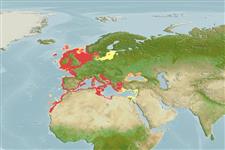
Θαλασσινό(ά); Υφάλμυρο βενθικό(ς); ωκεανόδρομο(ς) (Ref. 51243); εύρος βάθους 5 - 150 m (Ref. 247). Temperate; 63°N - 21°N, 19°W - 42°E
East Atlantic. Its range and abundance is declining severely throughout its range. There is a proposed legal protection in Britain (Ref. 58085). The European Council Regulations 43/2009, 23/2010, 57/2011, 44/2012, 40/2013, 43/2014, 2015/104 and 2016/72 prohibit to fish for, to retain on board, to tranship and to land this species in all waters from the European Community (F. Osaer, pers.comm. 04/2016).
Μήκος κατά την πρώτη ωρίμανση / Μέγεθος / Βάρος / Ηλικία
Γεννητική Ωρίμανση: Lm 147.5, range 102 - 169 cm
Max length : 183 cm TL αρσενικό/απροσδιόριστο; (Ref. 247); 244.0 cm TL (female); common length : 150 cm TL αρσενικό/απροσδιόριστο; (Ref. ); μεγ. δημοσιευμένο βάρος: 80.0 kg (Ref. 35388)
Σύντομη περιγραφή
Κλείδες προσδιορισμού | Μορφολογία | Μορφομετρία
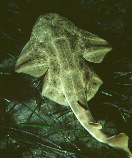
Ραχιαίες άκανθες (συνολικά) : 0. Broad flattened body, with enlarged pectoral and pelvic fins, no anal fin. Eyes and large spiracles dorsally. Gill openings at the sides of the head. The mouth is terminal. Coloration variable, from grey to reddish or greenish-brown with scattered small white spots and blackish dots dorsally (Ref. 78469). No ocelli on body (Ref. 247).
Body shape (shape guide): other.
A benthic species that occurs inshore, on coasts and along the continental shelf; may enter estuaries (Ref. 247, 58085). Found mainly on sand or mud bottoms; sluggish by day, lying buried with eyes protruding. Also utilizes areas with macroalgae, kelp or rocks (Ref. 88920). Nocturnal species, swims off bottom at night. Feeds mainly on flatfishes and other benthic fishes, but also on skates, crustaceans and molluscs, with one record of swallowed cormorant (Ref. 247, 28070). Moves to deeper waters during winter, returning to the shallower depths in the spring (Ref. 88187), moving northwards in summer. Ovoviviparous (Ref. 50449, 107715). Females generally grow larger than males (Ref. 58137, 107710, 107713, 107715). Detects weak electric fields generated by other organisms (e.g. potential prey) (Ref. 10311). The marine leech Stibarobdella macrothela is a common parasite (Ref. 107712) and the isopod Aegapheles deshaysiana a common micropredator (Ref. 107714) for this shark species in the Canary Islands. Utilized fresh and dried salted for human consumption, and possibly for oil and fishmeal (Ref. 247). Reaches 250 cm (Ref. 35388).
Ovoviviparous, produce 7-25 pups/litter (Ref. 58085), 13.0 +/- 1.9 pups in the Canary Is (Ref. 107713) with litter number increasing with female size. Gestation period lasts for 8-10 months (born Dec-Feb in Mediterranean, July in England) (Ref. 58085), and +/- 6 months in the Canary Is (Ref. 107713). Size at birth ranges from 24-30 cm TL (Ref. 58085). Embryos feed solely on yolk (Ref. 50449). Full term embryos weighed 189-200 g; no egg capsules found around ova or embryos (Ref. 107715). A biannual reproductive cycle is likely the case for this species (Ref. 32746), triannual cycle in the Canary Is (Ref. 107713).
Compagno, L.J.V., 1984. FAO Species Catalogue. Vol. 4. Sharks of the world. An annotated and illustrated catalogue of shark species known to date. Part 1 - Hexanchiformes to Lamniformes. FAO Fish. Synop. 125(4/1):1-249. Rome, FAO. (Ref. 247)
Κατάσταση Κόκκινου Καταλόγου IUCN (Ref. 130435: Version 2025-2 (Global))
Απειλή για τον άνθρωπο
Traumatogenic
Ανθρώπινες χρήσεις
αλιεία: περιορισμένης εμπορικότητας; αλιεία αναψυχής: ναί
Εργαλεία
Ειδικές εκθέσεις
Λήψη XML
Διαδικτυακές πηγές
Εκτιμήσεις βάσει μοντέλων
Προτιμώμενη θερμοκρασία (Αναφ.
123201): 7.7 - 19.4, mean 11.4 °C (based on 854 cells).
Δείκτης φυλογενετικής ποικιλότητας (Αναφ.
82804): PD
50 = 0.5000 [Uniqueness, from 0.5 = low to 2.0 = high].
Bayesian length-weight: a=0.00832 (0.00430 - 0.01608), b=3.05 (2.87 - 3.23), in cm total length, based on LWR estimates for this species & Genus-body shape (Ref.
93245).
Τροφικό Επίπεδο (Αναφ.
69278): 4.1 ±0.5 se; based on diet studies.
Ελαστικότητα (Αναφ.
120179): Χαμηλό, ελάχιστος χρόνος για διπλασιασμό πληθυσμού 4,5 - 14 έτη (Fec=9-20).
Prior r = 0.27, 95% CL = 0.18 - 0.41, Based on 1 data-limited stock assessment.
Ευπάθεια στην αλιεία (Ref.
59153): Very high vulnerability (90 of 100).
🛈
Ευπάθεια στο κλίμα (Ref.
125649): Moderate vulnerability (40 of 100).
🛈
Θρεπτικά συστατικά (Ref.
124155): Calcium = 3.58 [0.60, 65.38] mg/100g; Iron = 0.23 [0.02, 2.63] mg/100g; Protein = 18.2 [16.1, 20.5] %; Omega3 = 0.464 [0.160, 1.307] g/100g; Selenium = 12.7 [2.6, 61.3] μg/100g; VitaminA = 6.41 [0.58, 72.79] μg/100g; Zinc = 0.324 [0.023, 3.530] mg/100g (wet weight);