Elasmobranchi (squali e razze) (sharks and rays) >
Heterodontiformes (Bullhead and horn sharks) >
Heterodontidae (Bullhead, horn, or Port Jackson sharks)
Etymology: Heterodontus: heteros (Gr.), different; odontos (Gr.), tooth, referring to pointy teeth (for clutching prey) at front of jaws, different than rounded molar-like teeth (for grinding hard-shelled invertebrates) at the back (See ETYFish); portusjacksoni: Of Port Jackson, Sydney, New South Wales, near Botany Bay, type locality (See ETYFish).
Eponymy: As the name implies, this shark is named after a place: Port Jackson, Sydney, New South Wales, near Botany Bay, where the type specimen was collected. [...] (Ref. 128868), visit book page.
Ambiente: milieu / zona climatica / distribuzione batimetrica / gamma di distribuzione
Ecologia
marino demersale; oceanodromo (Ref. 51243); distribuzione batimetrica 0 - 275 m (Ref. 26346). Subtropical; 23°S - 44°S, 112°E - 154°E
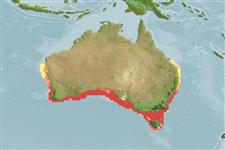
Western Pacific: southern Australia (including Western Australia) and one record from New Zealand. Heterodontus bona-spei from South Africa probably refers to this species.
Lunghezza alla prima maturità / Dimensione / Peso / Età
Maturità: Lm 87.5, range 80 - 95 cm
Max length : 165 cm TL maschio/sesso non determinato; (Ref. 247); common length : 137 cm TL maschio/sesso non determinato; (Ref. 247)
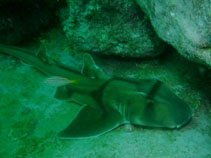
Spine dorsali (totale) : 2; Spine anali: 0. Harness-like narrow dark stripes on back (Ref. 9838).
Body shape (shape guide): elongated.
A common shark of the continental shelves (Ref. 9838), from close inshore at the intertidal zone to 275 m (Ref. 6871). Segregates by sex and maturity stage (Ref. 6871). Nocturnal, hides in caves and rocky gullies during the day (Ref. 6871). Feeds on benthic invertebrates, primarily echinoderms (Ref. 247). Oviparous (Ref. 50449). Eggs with spiral flanges but lack tendrils (Ref. 6871). Undergoes yearly migrations to spawning sites during breeding season (Ref. 247). Considered harmless to people, but can deliver a painful nip when provoked (Ref. 247).
Oviparous. Distinct pairing with embrace (Ref. 205). Undergoes yearly migrations to breeding sites. Females lay about 10 to 16 (commonly 10-12) eggs in rock crevices on shallow sheltered reefs at depths of 1-5 m (rarely 20-30 m) during August and September (rarely in July and October). In captivity, females lay 2 eggs a day every 8-17 days. Eggs are hatched after 9-12 months and young then move into nursery areas in bays and estuaries. After the breeding season, males move into deeper waters followed by the females in late September or October.
Compagno, L.J.V., 1984. FAO Species Catalogue. Vol. 4. Sharks of the world. An annotated and illustrated catalogue of shark species known to date. Part 1 - Hexanchiformes to Lamniformes. FAO Fish. Synop. 125(4/1):1-249. Rome, FAO. (Ref. 247)
Stato della Lista Rossa IUCN (Ref. 130435: Version 2025-2 (Global))
Usi umani
Pesca: scarso interesse commerciale; Acquario: Acquari pubblici
Strumenti
Rapporti speciali
Scarica XML
Fonti Internet
Stime basate su modelli
Temperatura preferita (Fonte Biblio.
123201): 14.1 - 22.6, mean 16.8 °C (based on 178 cells).
Indice di diversità filogenetica (Fonte Biblio.
82804): PD
50 = 0.5029 [Uniqueness, from 0.5 = low to 2.0 = high].
Bayesian length-weight: a=0.00347 (0.00258 - 0.00466), b=3.17 (3.08 - 3.26), in cm total length, based on LWR estimates for this species (Ref.
93245).
Livello trofico (Fonte Biblio.
69278): 3.5 ±0.48 se; based on food items.
Resilienza (Fonte Biblio.
120179): Basso, tempo minimo di raddoppiamento della popolazione 4.5 - 14 anni (tm=8-10; Fec=10).
Vulnerabilità della pesca (Ref.
59153): High to very high vulnerability (72 of 100).
🛈
Nutrienti (Ref.
124155): Calcium = 17.6 [3.6, 78.9] mg/100g; Iron = 0.653 [0.164, 1.934] mg/100g; Protein = 19.2 [17.1, 21.1] %; Omega3 = 0.215 [0.096, 0.466] g/100g; Selenium = 34.5 [10.4, 97.4] μg/100g; VitaminA = 5.8 [1.9, 16.9] μg/100g; Zinc = 0.526 [0.262, 0.951] mg/100g (wet weight);