sub class Elasmobranchii (ฉลามและกระเบน) (sharks and rays) >
Heterodontiformes (Bullhead and horn sharks) >
Heterodontidae (Bullhead, horn, or Port Jackson sharks)
Etymology: Heterodontus: heteros (Gr.), different; odontos (Gr.), tooth, referring to pointy teeth (for clutching prey) at front of jaws, different than rounded molar-like teeth (for grinding hard-shelled invertebrates) at the back (See ETYFish); quoyi: In honor of naval surgeon and naturalist Jean René Constant Quoy (1790‒1869), for his friendship, his “tireless zeal and extensive knowledge” (translation) of zoology, and for lessons and advice that have guided Fréminville in his study of science (See ETYFish).
Eponymy: Jean René Constant Quoy (1790–1869) was a French naval surgeon and zoologist who named many species, often with Joseph Paul Gaimard (q. [...] (Ref. 128868), visit book page.
สิ่งแวดล้อม : สิ่งแวดล้อม / เขตภูมิอากาศ / ระดับความลึก / ระยะการกระจายสินค้า
นิเวศวิทยา
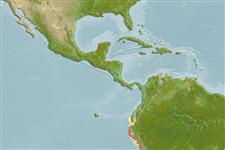
เกี่ยวกับทะเล,น้ำเค็ม เกี่ยวกับหินโสโครก; ระดับความลึก 3 - 40 m (Ref. 5227), usually 16 - 30 m (Ref. 54549). Tropical; 0°S - 10°S, 90°W - 71°W
Eastern Pacific: Peru (including offshore islands) and the Galapagos Islands. There might be another Heterodontus species from Peru which is Heterodontus peruanus, but these two cannot be separated as of this time for lack of materials examined.
ขนาด / น้ำหนัก / อายุ
วัยเจริญพันธุ์: Lm ? range ? - ? cm
Max length : 107 cm SL เพศผู้/กระเทย; (Ref. 5227)
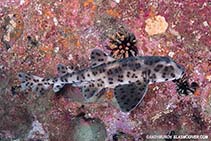
Inhabits sand flat and rocky, boulder strewn reef areas, with sand between outcroppings in inshore continental and insular waters. Rests motionless on the bottom. Is docile, non-aggressive and a poor swimmer (Ref. 5227). Nocturnal (Ref. 43278). Feeds on shellfish, crabs, and small invertebrates (Ref. 28023). Oviparous (Ref. 50449). Size at birth (for a newly hatched male) is 17 cm.
วงจรชีวิตและพฤติกรรมการผสมพันธุ์
วัยเจริญพันธุ์ | การสืบพันธุ์ | การวางไข่ | เซลสืบพันธ์ของเพศเมีย(ไข่) | ความดกของไข่ | ตัวอ่อน
Oviparous, paired eggs are laid. Embryos feed solely on yolk (Ref. 50449). Distinct pairing with embrace (Ref. 205).
Compagno, L.J.V., 1984. FAO Species Catalogue. Vol. 4. Sharks of the world. An annotated and illustrated catalogue of shark species known to date. Part 1 - Hexanchiformes to Lamniformes. FAO Fish. Synop. 125(4/1):1-249. Rome, FAO. (Ref. 247)
สถานะบัญชีแดงของ IUCN (Ref. 130435: Version 2025-2 (Global))
ภัยคุกคามต่อมนุษย์
Traumatogenic
การใช้ของมนุษย์
การประมง: ไม่มีผลประโยชน์
เครื่องมือ
รายงานพิเศษ
ดาวน์โหลด XML
แหล่งที่มาจากอินเตอร์เน็ต
การประมาณค่าตามแบบจำลอง
อุณหภูมิที่ต้องการ (อ้างอิง
123201): 17.7 - 23.2, mean 20.5 °C (based on 16 cells).
ดัชนีความหลากหลายทางวิวัฒนาการ (อ้างอิง
82804): PD
50 = 0.5029 [Uniqueness, from 0.5 = low to 2.0 = high].
Bayesian length-weight: a=0.00380 (0.00163 - 0.00884), b=3.15 (2.95 - 3.35), in cm total length, based on LWR estimates for this (Sub)family-body shape (Ref.
93245).
ระดับชั้นอาหาร (อ้างอิง
69278): 3.5 ±0.50 se; based on food items.
ความสามารถในการกลับคืนสู่ปกติ (อ้างอิง
120179): ต่ำ, เวลาต่ำสุดที่จะทำให้ประชากรเพิ่มขึ้นเป็น 2 เท่าใช้เวลา 4.5 - 14 ปี (Fec assumed to be <100).
ความเสี่ยงต่อการตกปลา (Ref.
59153): Very high vulnerability (78 of 100).
🛈
สารอาหาร (Ref.
124155): Calcium = 12.5 [2.4, 47.7] mg/100g; Iron = 0.364 [0.088, 1.020] mg/100g; Protein = 19.2 [17.1, 21.3] %; Omega3 = 0.0756 [, ] g/100g; Selenium = 27.9 [8.7, 80.7] μg/100g; VitaminA = 53.7 [17.4, 155.9] μg/100g; Zinc = 0.969 [0.473, 1.973] mg/100g (wet weight);