>
Anguilliformes (Eels and morays) >
Nettastomatidae (Duckbill eels)
Etymology: Nettastoma: Greek, netta = duck + Greek, stoma = mouth (Ref. 45335); solitarium: From the Latin solitarius meaning solitary, alone, lonely, in reference to the isolated and widely scattered distribution of this species in the Indo-Pacific.
Umwelt: Milieu / Klimazone / Tiefenbereich / Verbreitungsgebiet
Ökologie
seewasser benthopelagisch; tiefenbereich 415 - 610 m (Ref. 40819). Deep-water
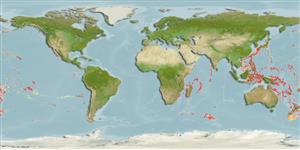
Indo-West Pacific: Kyushu-Palau Ridge, the Philippines, Australia, and the western Indian Ocean (Ref. 559). Reported from the Hawaiian Islands (Ref. 58302).
Größe / Gewicht / Alter
Geschlechtsreife: Lm ? range ? - ? cm
Max length : 46.5 cm TL Männchen/unbestimmt; (Ref. 40819)
Kurzbeschreibung
Bestimmungsschlüssel | Morphologie | Morphometrie
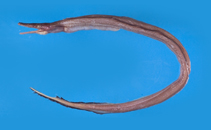
Six supraorbital pores, SO5 present. Lateral line pores 42-45. Median vomerine teeth somewhat enlarged. Posterior nostril above anterodorsal corner of eye.
Body shape (shape guide): eel-like.
Recorded on video tape outside the coelacanth caves at a depth of 278-340 m (Ref. 58472).
Lebenszyklus und Paarungsverhalten
Geschlechtsreife | Fortpflanzung | Ablaichen | Eier | Fruchtbarkeit | Larven
Paxton, J.R., D.F. Hoese, G.R. Allen and J.E. Hanley, 1989. Pisces. Petromyzontidae to Carangidae. Zoological Catalogue of Australia, Vol. 7. Australian Government Publishing Service, Canberra, 665 p. (Ref. 7300)
IUCN Rote Liste Status (Ref. 130435: Version 2025-2 (Global))
Bedrohung für Menschen
Harmless
Nutzung durch Menschen
Tools
Zusatzinformationen
Download XML
Internet Quellen
Schätzungen auf der Grundlage von Modellen
Bevorzugte Temperatur (Ref.
123201): 2.3 - 11.5, mean 8.5 °C (based on 154 cells).
Phylogenetischer Diversitätsindex (Ref.
82804): PD
50 = 0.5312 [Uniqueness, from 0.5 = low to 2.0 = high].
Bayesian length-weight: a=0.00087 (0.00035 - 0.00219), b=2.98 (2.76 - 3.20), in cm total length, based on LWR estimates for this (Sub)family-body shape (Ref.
93245).
Trophische Ebene (Ref.
69278): 3.4 ±0.5 se; based on size and trophs of closest relatives
Widerstandsfähigkeit (Ref.
120179): niedrig, Verdopplung der Population dauert 4,5 - 14 Jahre. (Assuming tmax>10).
Anfälligkeit der Fischerei (Ref.
59153): Moderate vulnerability (37 of 100).
🛈