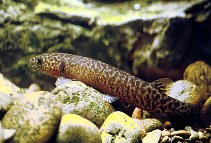
Environnement : milieu / zone climatique / profondeur / gamme de distribution
Écologie
marin; eau douce; saumâtre benthopélagique; amphidrome (Ref. 138269). Subtropical; 34°S - 53°S
Oceania: found in southeastern Australia in streams draining east and south from the Great Dividing Range; Flinders and King Islands in Bass Strait; widespread in Tasmania; also in New Zealand and the Chatham, Auckland and Campbell Islands.
Taille / Poids / Âge
Maturité: Lm ? range ? - ? cm
Max length : 28.0 cm SL mâle / non sexé; (Ref. 44894); common length : 15.0 cm SL mâle / non sexé; (Ref. 44894)
Facultative air-breathing (Ref. 126274); Adults inhabit mainly clear streams, often deeply shaded and relatively fast-flowing, although it sometimes occurs in lakes, particularly in Tasmania. In New Zealand and parts of Tasmania, juveniles occur in marine waters, presumably the larvae are washed out to the sea. The existence of a marine stage is regarded to be facultative rather than obligatory in Australia. They swim near the bottom, usually around the cover of rocks and logs. More common in uploads (Snowy Mountains, Otway Ranges, central Tasmania) than at lower elevations (Ref. 44894).
Cycle de vie et comportement reproducteur
Maturité | Reproduction | Frai | Œufs | Fécondité | Larves
Allen, G.R., 1989. Freshwater fishes of Australia. T.F.H. Publications, Inc., Neptune City, New Jersey. (Ref. 5259)
Statut dans la liste rouge de l'IUCN (Ref. 130435: Version 2025-2 (Global))
Menace pour l'homme
Harmless
Utilisations par l'homme
Pêcheries: commercial; appât: usually
Outils
Articles particuliers
Télécharger en XML
Sources Internet
Estimations basées sur des modèles
Indice de diversité phylogénétique (Réf.
82804): PD
50 = 0.5000 [Uniqueness, from 0.5 = low to 2.0 = high].
Bayesian length-weight: a=0.00490 (0.00206 - 0.01165), b=3.12 (2.91 - 3.33), in cm total length, based on LWR estimates for this (Sub)family-body shape (Ref.
93245).
Niveau trophique (Réf.
69278): 3.5 ±0.2 se; based on diet studies.
Résilience (Réf.
120179): Milieu, temps minimum de doublement de population : 1,4 à 4,4 années (Preliminary K or Fecundity.).
Vulnérabilité de la pêche (Ref.
59153): Low vulnerability (24 of 100).
🛈