>
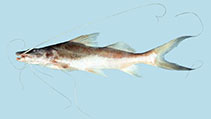
Siluriformes (Catfishes) >
Pimelodidae (Long-whiskered catfishes)
Etymology: Brachyplatystoma: Greek, brachys, eia = short + Greek, platys = flat + Greek, stoma = mouth (Ref. 45335).
Eponymy: François Levaillant (1753–1824) was a French traveller, explorer, collector and naturalist. [...] (Ref. 128868), visit book page.
More on author: Valenciennes.
Environnement : milieu / zone climatique / profondeur / gamme de distribution
Écologie
; eau douce; saumâtre démersal; potamodrome (Ref. 138143). Tropical
South America: Amazon and Orinoco River basins and major rivers of the Guianas and northeastern Brazil.
Taille / Poids / Âge
Maturité: Lm ? range ? - ? cm
Max length : 150 cm TL mâle / non sexé; (Ref. 5217); common length : 80.0 cm TL mâle / non sexé; (Ref. 5217); poids max. publié: 20.0 kg (Ref. 5273)
Juveniles and subadults frequently found at river mouths and estuaries. They occur downstream from the first falls where the water is charged with mud and the bottom is muddy. In the Amazon, they can sometimes be caught in the upper part up to the foot of the Andean range where they appear to be more rare than Brachyplatystoma filamentosum and Brachyplatystoma flavicus but never in the zones prone to flood. Reproductive migrations probably occur like in other Brachyplatystoma (Ref. 35381). Usually caught with longlines and drift nets (Ref. 35381). Flesh of excellent quality is highly appreciated.
Cycle de vie et comportement reproducteur
Maturité | Reproduction | Frai | Œufs | Fécondité | Larves
Lundberg, J.G. and M.W. Littmann, 2003. Pimelodidae (Long-whiskered catfishes). p. 432-446. In R.E. Reis, S.O. Kullander and C.J. Ferraris, Jr. (eds.) Checklist of the Freshwater Fishes of South and Central America. Porto Alegre: EDIPUCRS, Brasil. (Ref. 36506)
Statut dans la liste rouge de l'IUCN (Ref. 130435: Version 2025-2 (Global))
Menace pour l'homme
Harmless
Utilisations par l'homme
Pêcheries: commercial; pêche sportive: oui
Outils
Articles particuliers
Télécharger en XML
Sources Internet
Estimations basées sur des modèles
Indice de diversité phylogénétique (Réf.
82804): PD
50 = 0.5078 [Uniqueness, from 0.5 = low to 2.0 = high].
Bayesian length-weight: a=0.00501 (0.00290 - 0.00865), b=3.17 (3.02 - 3.32), in cm total length, based on LWR estimates for this species & (Sub)family-body (Ref.
93245).
Niveau trophique (Réf.
69278): 4.5 ±0.80 se; based on food items.
Résilience (Réf.
120179): Faible, temps minimum de doublement de population : 4,5 à 14 années (Preliminary K or Fecundity.).
Vulnérabilité de la pêche (Ref.
59153): Very high vulnerability (90 of 100).
🛈
Nutriments (Ref.
124155): Calcium = 63.2 [30.7, 128.1] mg/100g; Iron = 0.903 [0.480, 1.814] mg/100g; Protein = 17.1 [15.8, 18.6] %; Omega3 = 0.13 [0.07, 0.24] g/100g; Selenium = 51.3 [25.7, 120.9] μg/100g; VitaminA = 19.3 [7.2, 52.2] μg/100g; Zinc = 0.798 [0.552, 1.166] mg/100g (wet weight);