Elasmobranchii (tubarões e raias) (sharks and rays) >
Orectolobiformes (Carpet sharks) >
Orectolobidae (Carpet or nurse sharks)
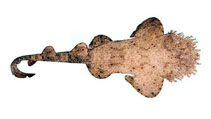
Etymology: Eucrossorhinus: eu (Gr.), very; Crossorhinus (=Orectolobus), previous genus, from krossos (Gr.), fringe or tassel, referring to tassel of dermal lobes fringing the head, and rhinus, an ancient name for sharks, from rhine (Gr.), rasp, alluding to their rasp-like skin, or rhinos, snout, referring to “lobe-like attachments from the nose” (translation, from Müller & Henle’s 1837 description of Crossorhinus) (See ETYFish); dasypogon: dasys (Gr.), hairy; pogon (Gr.), beard, referring to dense beard-like tassel of dermal lobes fringing the head (See ETYFish).
More on author: Bleeker.
Ambiente: milieu / zona climática / intervalo de profundidade / gama de distribuição
Ecologia
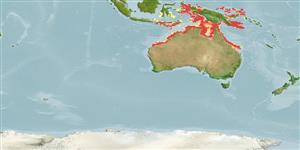
marinhas associadas(os) a recifes; intervalo de profundidade 2 - 50 m (Ref. 106604). Deep-water; 1°N - 23°S, 115°E - 155°E
Indo-West Pacific: eastern Indonesia, Papua New Guinea, and northern Australia (including Barrow Island, Western Australia). Questionable occurrence in Malaysia.
Tamanho / Peso / Idade
Maturidade: Lm ? range ? - ? cm
Max length : 366 cm TL macho/indeterminado; (Ref. 90102); common length : 180 cm TL macho/indeterminado; (Ref. 90102)
Espinhos dorsais (total) : 0; Espinhos anais: 0. Body with a reticular pattern of narrow dark lines (Ref. 13577). Caudal fin with its upper lobe hardly elevated above the body axis, with a strong terminal lobe and subterminal notch but no ventral lobe (Ref. 13577).
Body shape (shape guide): elongated.
A little-known shark (Ref. 247) found on the continental shelf and offshore reefs (Ref. 6871). Probably feeds on bottom fishes and invertebrates (Ref. 13577, 43278); also known to eat nocturnal teleost fishes such as squirrelfish and soldierfish (Holocentridae) and sweepers (Pempheridae) (Ref. 43278). Ovoviviparous (Ref. 50449). Might bite in self-defense or when mistaking a human foot for its usual prey (Ref. 247). Its tough skin sometimes used for leather (Ref. 13577). The maximum length of 366 cm TL reported for this species is uncertain (Ref. 247, 90102).
Ciclo de vida e comportamento de acasalamento
Maturidade | Reprodução | Desova | Ovos | Fecundidade | Larvas
Ovoviviparous, embryos feed solely on yolk (Ref. 50449).
Compagno, L.J.V., 1984. FAO Species Catalogue. Vol. 4. Sharks of the world. An annotated and illustrated catalogue of shark species known to date. Part 1 - Hexanchiformes to Lamniformes. FAO Fish. Synop. 125(4/1):1-249. Rome, FAO. (Ref. 247)
Categoria na Lista Vermelha da IUCN (Ref. 130435: Version 2025-2 (Global))
Utilização humana
Pescarias: bycatch
Ferramentas
Relatórios especiais
Descarregue XML
Fontes da internet
Estimativas baseadas em modelos
Temperatura preferida (Ref.
123201): 26.2 - 28.8, mean 27.8 °C (based on 294 cells).
Índice de diversidade filogenética (Ref.
82804): PD
50 = 1.0002 [Uniqueness, from 0.5 = low to 2.0 = high].
Bayesian length-weight: a=0.00389 (0.00180 - 0.00842), b=3.12 (2.94 - 3.30), in cm total length, based on all LWR estimates for this body shape (Ref.
93245).
Nível Trófico (Ref.
69278): 4.0 ±0.60 se; based on food items.
Resiliência (Ref.
120179): Baixo, tempo mínimo de duplicação da população 4,5 - 14 anos (Fec assumed to be <100).
Vulnerabilidade da pesca (Ref.
59153): Very high vulnerability (90 of 100).
🛈
Nutrientes (Ref.
124155): Calcium = 1.57 [0.18, 7.23] mg/100g; Iron = 0.125 [0.027, 0.423] mg/100g; Protein = 19.4 [17.1, 21.6] %; Omega3 = 0.0936 [, ] g/100g; Selenium = 7.92 [2.19, 30.75] μg/100g; VitaminA = 13.4 [2.3, 84.0] μg/100g; Zinc = 0.248 [0.114, 0.523] mg/100g (wet weight);