Milieu: milieu / Klimaatzone / Diepte / verspreidingsgebied
Ecologie
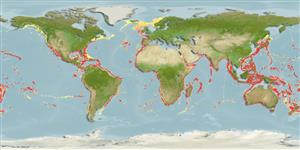
marien benthopelagisch; diepte 200 - 1200 m (Ref. 6181). Deep-water; 70°N - 47°S, 180°W - 180°E
Probably distributed worldwide in tropical and subtropical seas except in eastern Pacific and northern Indian oceans. Large-sized individuals stray in cold-temperate waters off Iceland, Norway, northern Japan and southern New Zealand (Ref. 6181). Reported from 19°41'S, 79°11'W (Ref. 11892).
Grootte / Gewicht / Leeftijd
Maturiteit: Lm ? range ? - ? cm
Max length : 130 cm SL mannelijk / geslacht onbekend; (Ref. 6181); common length : 80.0 cm SL mannelijk / geslacht onbekend; (Ref. 6181)
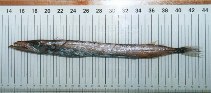
Dorsale stekels (totaal) : 20 - 22; Dorsale zachte stralen (totaal) : 19 - 24; Anale stekels: 2; Anale zachte stralen: 18 - 21; Wervels: 34 - 36. Body fairly elongate and strongly compressed. Mouth with fang-like teeth. The tips of both jaws with dermal processes. Gill rakers degenerated. Color is dark brown with violet tint; fin membranes black; margin of anus black (Ref. 6181).
Body shape (shape guide): elongated; Cross section: compressed.
Adults, benthopelagic to mesopelagic, dwell on the continental slope or underwater rises, migrating to midwater at night (Ref. 6181). Eggs are pelagic (Ref. 6766). Larvae and juveniles, epipelagic to mesopelagic, are rather common in oceanic ichthyoplankton and are only found in the tropics (Ref. 6181). Feed on squid, fish and crustaceans (Ref. 6181). Consumed as food (Ref. 4537).
Levenscyclus en paargedrag
Maturiteit | Voortplanting | Paaien | Eieren | Fecunditeit | Larven
Nakamura, I. and N.V. Parin, 1993. FAO Species Catalogue. Vol. 15. Snake mackerels and cutlassfishes of the world (families Gempylidae and Trichiuridae). An annotated and illustrated catalogue of the snake mackerels, snoeks, escolars, gemfishes, sackfishes, domine, oilfish, cutlassfishes,. scabbardfishes, hairtails, and frostfishes known to date. FAO Fish. Synop. 125(15):136 p. (Ref. 6181)
Status op de Rode Lijst van het IUCN (Ref. 130435: Version 2025-2 (Global))
Gevaar voor de mens
Harmless
Gebruik door de mens
Visserij: van minder commercieel belang
Tools
Speciale rapporten
Download XML
Internetbronnen
Schattingen op basis van modellen
Gewenste temperatuur (Ref.
123201): 6.6 - 14.3, mean 9.6 °C (based on 988 cells).
Fylogenetische diversiteitsindex (Ref.
82804): PD
50 = 1.0000 [Uniqueness, from 0.5 = low to 2.0 = high].
Bayesian length-weight: a=0.00372 (0.00169 - 0.00815), b=3.11 (2.92 - 3.30), in cm total length, based on LWR estimates for this (Sub)family-body shape (Ref.
93245).
Trofisch niveau (Ref.
69278): 4.3 ±0.71 se; based on food items.
Weerstandsvermogen (Ref.
120179): laag, minimale populatieverdubbelingstijd 4,5-14 jaar (Preliminary K or Fecundity.).
Kwetsbaarheid van de visserij (Ref.
59153): Very high vulnerability (90 of 100).
🛈
Voedingsstoffen (Ref.
124155): Calcium = 10.7 [5.1, 22.9] mg/100g; Iron = 0.283 [0.121, 0.617] mg/100g; Protein = 16.5 [14.4, 18.5] %; Omega3 = 0.266 [0.107, 0.654] g/100g; Selenium = 20.2 [5.3, 65.7] μg/100g; VitaminA = 14.7 [3.3, 68.7] μg/100g; Zinc = 0.266 [0.129, 0.522] mg/100g (wet weight);