>
Eupercaria/misc (Various families in series Eupercaria) >
Labridae (Wrasses) > Cirrhilabrinae
Etymology: Cirrhilabrus: Latin, cirrus = curl fringe + Greek, labros = furious (Ref. 45335).
Eponymy: Katherine A Meyer was the wife of John W Shepard of the Marine Laboratory at Guam. The etymology says: “This species is named katherinae in honour of Katherine A. Meyer, the late wife of John W. Shepard, at his request.” (Ref. 128868), visit book page.
More on author: Randall.
Environnement : milieu / zone climatique / profondeur / gamme de distribution
Écologie
marin récifal; profondeur 10 - 50 m (Ref. 37816). Tropical
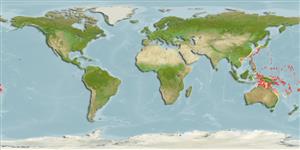
Western Pacific: Miyake-jima, Izu Islands, Japan, Guam and the Mariana Islands.
Taille / Poids / Âge
Maturité: Lm ? range ? - ? cm
Max length : 7.1 cm SL mâle / non sexé; (Ref. 5278)
Description synthétique
Clés d'identification | Morphologie | Morphométrie
Épines dorsales (Total) : 11; Rayons mous dorsaux (Total) : 9; Épines anales: 3; Rayons mous anaux: 9. Juveniles and females nearly uniformly orange-red. Males develop elongate pelvic fins and have brilliant blue bands on dorsal and anal fins.
Body shape (shape guide): fusiform / normal.
Known at depths ranging from 10 to at least 40 m at exposed outer reef areas than in lagoons or harbors. Occurs in aggregations. Maximum depth reported taken from Ref. 128797.
Cycle de vie et comportement reproducteur
Maturité | Reproduction | Frai | Œufs | Fécondité | Larves
Distinct pairing during breeding (Ref. 205).
Randall, J.E., 1992. A review of the labrid fishes of the genus Cirrhilabrus from Japan, Taiwan and the Mariana Islands, with descriptions of two new species. Micronesica 25(1):99-121. (Ref. 5278)
Statut dans la liste rouge de l'IUCN (Ref. 130435: Version 2025-2 (Global))
Menace pour l'homme
Harmless
Utilisations par l'homme
Outils
Articles particuliers
Télécharger en XML
Sources Internet
Estimations basées sur des modèles
Température préférée (Réf.
123201): 25.5 - 28.9, mean 27.7 °C (based on 124 cells).
Indice de diversité phylogénétique (Réf.
82804): PD
50 = 0.5000 [Uniqueness, from 0.5 = low to 2.0 = high].
Bayesian length-weight: a=0.01072 (0.00427 - 0.02691), b=3.03 (2.81 - 3.25), in cm total length, based on LWR estimates for this (Sub)family-body shape (Ref.
93245).
Niveau trophique (Réf.
69278): 3.3 ±0.4 se; based on size and trophs of closest relatives
Résilience (Réf.
120179): Haut, temps minimum de doublement de population inférieur à 15 mois (Preliminary K or Fecundity.).
Vulnérabilité de la pêche (Ref.
59153): Low vulnerability (10 of 100).
🛈
Nutriments (Ref.
124155): Calcium = 142 [82, 299] mg/100g; Iron = 1.04 [0.58, 2.05] mg/100g; Protein = 18.1 [15.2, 20.4] %; Omega3 = 0.18 [0.10, 0.32] g/100g; Selenium = 22.1 [11.4, 45.5] μg/100g; VitaminA = 290 [86, 1,071] μg/100g; Zinc = 2.06 [1.32, 3.28] mg/100g (wet weight);