Elasmobranchi (squali e razze) (sharks and rays) >
Orectolobiformes (Carpet sharks) >
Orectolobidae (Carpet or nurse sharks)
Etymology: Orectolobus: orektos (Gr.), stretched out; lobus (L.), from lobos (Gr.), rounded projection or protuberance, referring to long nasal barbels of Squalus barbatus (=O. maculatus) (See ETYFish); wardi: In honor of Australian actor, musician and naturalist Charles Melbourne Ward (1903-1966), who collected holotype (See ETYFish).
Eponymy: Charles Melbourne Ward (1903–1966) was an actor, naturalist and marine collector. [...] (Ref. 128868), visit book page.
More on author: Whitley.
Ambiente: milieu / zona climatica / distribuzione batimetrica / gamma di distribuzione
Ecologia
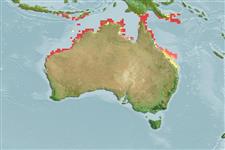
marino associati a barriera corallina; distribuzione batimetrica 1 - 3 m (Ref. 43278). Tropical; 9°S - 26°S, 114°E - 154°E
Western Central Pacific: Australia.
Dimensione / Peso / Età
Maturità: Lm ? range ? - ? cm
Max length : 63.0 cm TL maschio/sesso non determinato; (Ref. 6871)
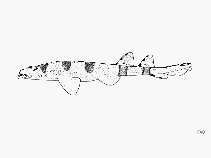
Spine dorsali (totale) : 0; Spine anali: 0. Dark rounded saddles with light outlining widely spaced by dusky areas and with a few dark spots; saddles on head and trunk forming conspicuous eyespots (Ref. 13577). Caudal fin with its upper lobe hardly elevated above the body axis, with a strong terminal lobe and subterminal notch but no ventral lobe (Ref. 13577).
Body shape (shape guide): elongated.
Found on the continental shelf, commonly inshore (Ref. 247). Presumably feeds on bottom invertebrates and fishes, but diet still unrecorded (Ref. 13577, 43278). Probably ovoviviparous (Ref. 13577, 43278). Wobbegongs should be regarded as potentially dangerous because of their formidable teeth (Ref. 247, 13577).
Ciclo vitale e comportamento di accoppiamento
Maturità | Riproduzione | Deposizione | Uova | Fecondità | Larve
Ovoviviparous, embryos feed solely on yolk (Ref. 50449).
Compagno, L.J.V., 1984. FAO Species Catalogue. Vol. 4. Sharks of the world. An annotated and illustrated catalogue of shark species known to date. Part 1 - Hexanchiformes to Lamniformes. FAO Fish. Synop. 125(4/1):1-249. Rome, FAO. (Ref. 247)
Stato della Lista Rossa IUCN (Ref. 130435: Version 2025-2 (Global))
Minaccia per l'uomo
Traumatogenic
Usi umani
Pesca: scarso interesse commerciale
Strumenti
Rapporti speciali
Scarica XML
Fonti Internet
Stime basate su modelli
Temperatura preferita (Fonte Biblio.
123201): 26.5 - 28.7, mean 28 °C (based on 253 cells).
Indice di diversità filogenetica (Fonte Biblio.
82804): PD
50 = 0.5012 [Uniqueness, from 0.5 = low to 2.0 = high].
Bayesian length-weight: a=0.00389 (0.00180 - 0.00842), b=3.12 (2.94 - 3.30), in cm total length, based on all LWR estimates for this body shape (Ref.
93245).
Livello trofico (Fonte Biblio.
69278): 4.0 ±0.61 se; based on food items.
Resilienza (Fonte Biblio.
120179): Basso, tempo minimo di raddoppiamento della popolazione 4.5 - 14 anni (Fec assumed to be <100).
Vulnerabilità della pesca (Ref.
59153): Moderate to high vulnerability (45 of 100).
🛈
Nutrienti (Ref.
124155): Calcium = 23 [4, 93] mg/100g; Iron = 0.446 [0.106, 1.244] mg/100g; Protein = 19.7 [17.4, 21.9] %; Omega3 = 0.073 [0.030, 0.179] g/100g; Selenium = 14.6 [3.9, 44.0] μg/100g; VitaminA = 67.4 [21.7, 190.8] μg/100g; Zinc = 0.967 [0.439, 2.052] mg/100g (wet weight);