>
Eupercaria/misc (Various families in series Eupercaria) >
Sciaenidae (Drums or croakers)
Etymology: Micropogonias: Greek, mikros = small + greek, pogon = beard (Ref. 45335).
Eponymy: Marcellin Fournier supplied specimens from Cuba. For some reason, Desmarest chose to omit the o from Fournier’s name in the scientific binomial furnieri. We have been unable to unearth any further information. (Ref. 128868), visit book page.
Taxonomic Remarks
The species Micropogonias opercularis (Quoy & Gaimard, 1825) is considered as valid in Eschmeyer (CofF ver. Jul. 2010: Ref. 84883) according to López et al. (2002: Ref. 80900).
Milieu: milieu / Klimaatzone / Diepte / verspreidingsgebied
Ecologie
marien; brak water demersaal; oceanodroom (Ref. 51243); diepte ? - 60 m (Ref. 9626), usually 20 - 40 m (Ref. 9626). Subtropical; 27°N - 36°S, 84°W - 34°W (Ref. 54591)
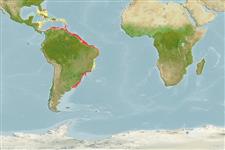
Western to Southwest Atlantic: Greater Antilles and from Costa Rica to Argentina (Ref. 9626). Also reported in Nicaragua (Ref. 13613). Also reported in Brazil (Ref. 118626).
Lengte bij maturiteit / Grootte / Gewicht / Leeftijd
Maturiteit: Lm 30.6 range ? - ? cm
Max length : 60.0 cm SL mannelijk / geslacht onbekend; (Ref. 27363); common length : 45.0 cm SL mannelijk / geslacht onbekend; (Ref. 27363); max. gepubliceerd gewicht: 55.30 g (Ref. 118626); max. gerapporteerde leeftijd: 7 Jaren (Ref. 27)
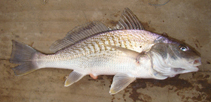
Dorsale stekels (totaal) : 11; Dorsale zachte stralen (totaal) : 26 - 30; Anale stekels: 2; Anale zachte stralen: 7 - 9. Body silvery with a golden cast, back greyish, with distinct oblique dark streaks along scale rows extending to much below lateral line; spinous dorsal without small dark dots (Ref. 27363).
Body shape (shape guide): short and / or deep.
Found over muddy and sandy bottoms in coastal waters and in estuaries where the nursery and feeding grounds are located. Adults form schools. Feeding habits vary with ontogenic development and season; juveniles feed on benthic migratory crustaceans and sessile boring mollusks while adults are benthos-feeders and occasionally capture fish (Ref. 27). Undergoes seasonal migration. An important food fish which is usually marketed fresh and salted.
Isaac, V.J., 1988. Synopsis of biological data on the whitemouth croaker, Micropogonias furnieri (Desmarest, 1823). FAO Fish. Synop. (150). (Ref. 27)
Status op de Rode Lijst van het IUCN (Ref. 130435: Version 2025-2 (Global))
Gevaar voor de mens
Harmless
Gebruik door de mens
Visserij: van groot commercieel belang
Tools
Speciale rapporten
Download XML
Internetbronnen
Schattingen op basis van modellen
Gewenste temperatuur (Ref.
123201): 16.5 - 28, mean 26.6 °C (based on 196 cells).
Fylogenetische diversiteitsindex (Ref.
82804): PD
50 = 0.5156 [Uniqueness, from 0.5 = low to 2.0 = high].
Bayesian length-weight: a=0.00955 (0.00793 - 0.01151), b=3.02 (2.96 - 3.08), in cm total length, based on LWR estimates for this species (Ref.
93245).
Trofisch niveau (Ref.
69278): 3.1 ±0.1 se; based on diet studies.
Generation time: 6.1 (4.3 - 8.5) years. Estimated as median ln(3)/K based on 12
growth studies.
Weerstandsvermogen (Ref.
120179): Gemiddeld, minimale populatieverdubbelingstijd 1,4-4,4 jaar (K=0.12-0.18; tmax=7).
Prior r = 0.71, 95% CL = 0.47 - 1.06, Based on 4 data-limited stock assessments.
Kwetsbaarheid van de visserij (Ref.
59153): Moderate to high vulnerability (48 of 100).
🛈
Kwetsbaarheid voor het klimaat (Ref.
125649): Moderate vulnerability (43 of 100).
🛈
Voedingsstoffen (Ref.
124155): Calcium = 82.4 [47.1, 158.8] mg/100g; Iron = 1.07 [0.58, 1.86] mg/100g; Protein = 20 [18, 22] %; Omega3 = 0.265 [0.134, 0.513] g/100g; Selenium = 28.3 [15.5, 53.0] μg/100g; VitaminA = 7.34 [2.76, 23.48] μg/100g; Zinc = 0.86 [0.63, 1.26] mg/100g (wet weight); based on
nutrient studies.