>
Eupercaria/misc (Various families in series Eupercaria) >
Haemulidae (Grunts) > Plectorhinchinae
Etymology: Plectorhinchus: Greek, plektos = plaited + Greek, rhyngchos = snout (Ref. 45335).
More on author: Cuvier.
Ambiente: milieu / zona climatica / distribuzione batimetrica / gamma di distribuzione
Ecologia
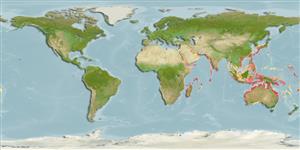
marino associati a barriera corallina; distribuzione batimetrica 2 - 80 m (Ref. 90102). Tropical; 35°N - 38°S, 28°E - 172°E
Indo-West Pacific: Red Sea south to Transkei, South Africa and east to Papua New Guinea, north to southern Japan, south to western Australia and New South Wales (Ref. 9710).
Lunghezza alla prima maturità / Dimensione / Peso / Età
Maturità: Lm ?, range 34 - ? cm
Max length : 60.0 cm TL maschio/sesso non determinato; (Ref. 2799)
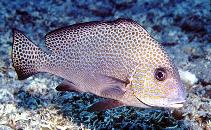
Spine dorsali (totale) : 12 - 13; Raggi dorsali molli (totale) : 19 - 22; Spine anali: 3; Raggi anali molli: 7. This species is distinguished by the following characters: chin with 6 pores, no median pit; gill rakers on first gill arch 11-14 + 1 + 16-19 = 26-34; D XII-XIII (mostly XIII),19-22, 4th or 5th spines longest; lips fleshy, moderately swollen with age; scales ctenoid (rough to touch); lateral line tubed scales about 53-60; body depth 2.5-2.8 in SL; caudal fin slightly rounded in juveniles becoming emarginate in adults. Colour of body bluish grey, juveniles with golden or rusty orange stripes along the body that break into a reticulate pattern and later form small spots that may be lost with age or remain as lines, or lines of spots on head (Ref. 47695, 90102).
Body shape (shape guide): fusiform / normal; Cross section: compressed.
Inhabits coastal inshore waters near sheltered reefs, lagoons, sandbanks and seagrass areas, solitarily or in groups (Ref. 47695, 90102). Adults usually on silty reefs at moderate depths, or in current channels occasionally inshore; juveniles enter estuaries and harbors (Ref. 48635). Feeds on small fishes and crustaceans (Ref. 5213). Taken by handline and spear. A common species marketed fresh, a small quantity is salted, good food fish (Ref. 47695). Maximum depth reported taken from Ref. 9773.
Ciclo vitale e comportamento di accoppiamento
Maturità | Riproduzione | Deposizione | Uova | Fecondità | Larve
Oviparous, distinct pairing during breeding (Ref. 205).
Masuda, H., K. Amaoka, C. Araga, T. Uyeno and T. Yoshino, 1984. The fishes of the Japanese Archipelago. Vol. 1. Tokai University Press, Tokyo, Japan. 437 p. (text). (Ref. 559)
Stato della Lista Rossa IUCN (Ref. 130435: Version 2025-2 (Global))
Minaccia per l'uomo
Harmless
Usi umani
Pesca: commerciale
Strumenti
Rapporti speciali
Scarica XML
Fonti Internet
Stime basate su modelli
Temperatura preferita (Fonte Biblio.
123201): 22 - 29.1, mean 27.6 °C (based on 2161 cells).
Indice di diversità filogenetica (Fonte Biblio.
82804): PD
50 = 0.5000 [Uniqueness, from 0.5 = low to 2.0 = high].
Bayesian length-weight: a=0.01380 (0.00863 - 0.02207), b=2.98 (2.85 - 3.11), in cm total length, based on LWR estimates for this species & Genus-body shape (Ref.
93245).
Livello trofico (Fonte Biblio.
69278): 3.8 ±0.58 se; based on food items.
Resilienza (Fonte Biblio.
120179): Medio, tempo minimo di raddoppiamento della popolazione 1.4 - 4.4 anni (Preliminary K or Fecundity.).
Vulnerabilità della pesca (Ref.
59153): Moderate vulnerability (44 of 100).
🛈
Nutrienti (Ref.
124155): Calcium = 30.4 [11.1, 57.1] mg/100g; Iron = 0.487 [0.256, 0.945] mg/100g; Protein = 19.6 [17.7, 21.4] %; Omega3 = 0.123 [0.066, 0.201] g/100g; Selenium = 29.4 [16.9, 50.6] μg/100g; VitaminA = 77.7 [30.5, 197.0] μg/100g; Zinc = 0.978 [0.674, 1.446] mg/100g (wet weight);