>
Ophidiiformes (Cusk eels) >
Ophidiidae (Cusk-eels) > Neobythitinae
Etymology: Bassozetus: Latin, bassus = thick, fat + Greek, ketos = marine mosnter, whale (Ref. 45335).
More on authors: Smith & Radcliffe.
Environnement : milieu / zone climatique / profondeur / gamme de distribution
Écologie
marin bathydémersal; profondeur 1035 - 4420 m (Ref. 75877), usually 1069 - 1922 m (Ref. 84269). Deep-water
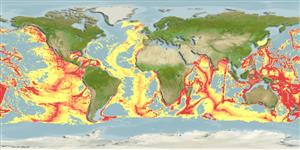
Circumglobal: In tropical to temperate waters.
Taille / Poids / Âge
Maturité: Lm ? range ? - ? cm
Max length : 64.0 cm SL mâle / non sexé; (Ref. 84269)
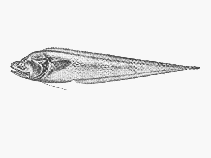
Épines dorsales (Total) : 0; Rayons mous dorsaux (Total) : 115 - 123; Épines anales: 0; Rayons mous anaux: 94 - 102; Vertèbres: 64. Snout inflated; eyes much smaller than snout; opercular spine weak or absent; preopercle without spines and posteriorly expanded almost reaching posterior margin of opercle; pseudobranchial filaments 2 (Ref. 34024).
Body shape (shape guide): elongated.
Benthopelagic at bathyal depth (Ref. 56809). Found on the continental slope (Ref. 75154). Common species (Ref. 34024). Oviparous, with oval pelagic eggs floating in a gelatinous mass (Ref. 205). Of the 36 female specimens caught, 3 with 0.5-1.0 mm eggs. No identifiable stomach contents were found (Ref. 84269).
Cycle de vie et comportement reproducteur
Maturité | Reproduction | Frai | Œufs | Fécondité | Larves
Nielsen, J.G., D.M. Cohen, D.F. Markle and C.R. Robins, 1999. Ophidiiform fishes of the world (Order Ophidiiformes). An annotated and illustrated catalogue of pearlfishes, cusk-eels, brotulas and other ophidiiform fishes known to date. FAO Fish. Synop. 125(18):178p. Rome: FAO. (Ref. 34024)
Statut dans la liste rouge de l'IUCN (Ref. 130435: Version 2025-2 (Global))
Menace pour l'homme
Harmless
Utilisations par l'homme
Pêcheries: sans intérêt
Outils
Articles particuliers
Télécharger en XML
Sources Internet
Estimations basées sur des modèles
Température préférée (Réf.
123201): 2.2 - 5.4, mean 3.4 °C (based on 3623 cells).
Indice de diversité phylogénétique (Réf.
82804): PD
50 = 0.5000 [Uniqueness, from 0.5 = low to 2.0 = high].
Bayesian length-weight: a=0.00380 (0.00165 - 0.00876), b=3.14 (2.93 - 3.35), in cm total length, based on LWR estimates for this (Sub)family-body shape (Ref.
93245).
Niveau trophique (Réf.
69278): 3.7 ±0.6 se; based on size and trophs of closest relatives
Résilience (Réf.
120179): Milieu, temps minimum de doublement de population : 1,4 à 4,4 années (Preliminary K or Fecundity.).
Vulnérabilité de la pêche (Ref.
59153): Moderate to high vulnerability (51 of 100).
🛈