Élasmobranches (requins et raies) (sharks and rays) >
Carcharhiniformes (Ground sharks) >
Pentanchidae (Deepwater catsharks)
Etymology: Apristurus: a-, Latin privative, i.e., without; pristis, from pristes (Gr.), sawyer (but here meaning saw); oura (Gr.), tail, referring to absence of saw-toothed crest of enlarged dermal denticles along upper edge of caudal fin as found in the closely related Pristiurus (=Galeus) (See ETYFish); brunneus: Medieval Latin for brown, referring to its “uniform warm brown” color above and below (See ETYFish).
More on author: Gilbert.
Environnement : milieu / zone climatique / profondeur / gamme de distribution
Écologie
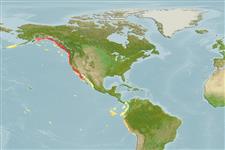
marin démersal; océanodrome (Ref. 138310); profondeur 33 - 1306 m (Ref. 96339). Subtropical; 60°N - 39°S, 138°W - 70°W (Ref. 56871)
Eastern Pacific: British Columbia, Canada to northern Baja California, Mexico. Probably south to Panama, Ecuador, and Peru.
Taille / Poids / Âge
Maturité: Lm ? range ? - ? cm
Max length : 69.0 cm TL mâle / non sexé; (Ref. 96339)
Description synthétique
Clés d'identification | Morphologie | Morphométrie
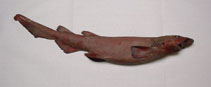
Épines dorsales (Total) : 0; Épines anales: 0. Dark brown, with conspicuous light posterior margin on fins (Ref. 247).
Body shape (shape guide): elongated.
Adults inhabit the outer continental shelf and upper slope (Ref. 244). Found over muddy or sandy bottoms (Ref. 27436). They feed on small true shrimps, euphausiid shrimps, squids, and small fishes (Ref. 244). Oviparous (Ref. 50449).
Cycle de vie et comportement reproducteur
Maturité | Reproduction | Frai | Œufs | Fécondité | Larves
Oviparous, with a single egg per oviduct (Ref. 244). Eggs are enclosed in oblong transparent cases with tendrils at each end (Ref. 6885). Embryos feed solely on yolk (Ref. 50449). In Canada, females carry egg cases from February to August (Ref. 244).
Compagno, L.J.V., 1984. FAO Species Catalogue. Vol. 4. Sharks of the world. An annotated and illustrated catalogue of shark species known to date. Part 2 - Carcharhiniformes. FAO Fish. Synop. 125(4/2):251-655. Rome: FAO. (Ref. 244)
Statut dans la liste rouge de l'IUCN (Ref. 130435: Version 2025-2 (Global))
Menace pour l'homme
Harmless
Utilisations par l'homme
Pêcheries: sans intérêt
Outils
Articles particuliers
Télécharger en XML
Sources Internet
Estimations basées sur des modèles
Température préférée (Réf.
123201): 5.6 - 9, mean 6.9 °C (based on 52 cells).
Indice de diversité phylogénétique (Réf.
82804): PD
50 = 0.5000 [Uniqueness, from 0.5 = low to 2.0 = high].
Bayesian length-weight: a=0.00347 (0.00172 - 0.00698), b=3.08 (2.90 - 3.26), in cm total length, based on LWR estimates for this (Sub)family-body shape (Ref.
93245).
Niveau trophique (Réf.
69278): 3.6 ±0.0 se; based on diet studies.
Résilience (Réf.
120179): Très faible, temps minimum de doublement de population supérieur à 14 ans (Fec assumed to be <10).
Vulnérabilité de la pêche (Ref.
59153): Moderate to high vulnerability (48 of 100).
🛈