>
Gobiiformes (Gobies) >
Gobiidae (Gobies) > Gobiinae
Etymology: Eviota: No etymology given, suggested by Christopher Scharpt: from Latin 'eu' for 'true' and 'iota' for anything very small, in combination 'truly very small' referring to it as being the smallest vertebrate at the time it has benn described by Jenkins (thus, making the suggestion by Scharpt plausible; irrasa: From the Latin irrasa meaning unpolished or unshaved, in reference to the indiscrete nature of the pigmentation pattern of the head and trunk (Ref. 5289).
More on authors: Karnella & Lachner.
Lingkungan: lingkungan / zona iklim / kisaran kedalaman / jangkauan distribusi
Ekologi
laut berasosiasi dengan karang; kisaran kedalaman 0 - 3 m (Ref. 58018). Tropical
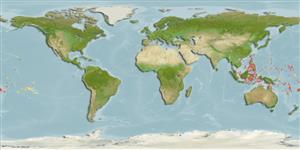
Western Pacific: Cuyo Islands, Palawan, Philippines and the Southwest Islands of Palau.
Ukuran / Berat / umur
Kematangan: Lm ? range ? - ? cm
Max length : 1.8 cm TL jantan/; (Ref. 5289)
deskripsi pendek
Kunci identifiaksi (pengenalan) | Morfologi | Morfometrik
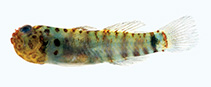
Duri punggung (Keseluruhan (total)) : 7; duri punggung lunak (Keseluruhan (total)) : 9; Duri dubur: 1; Sirip dubur lunak: 8; vertebrata, bertulang belakang: 26. Characterized by the following: base of pectoral fin with two dark circular to oval spots, not sharply defined and often weakly connected, the upper spot somewhat larger than the lower; pectoral spots moderately pigmented, the intensity about equal to trunk bars; head (dorsally) and nape with dark, transverse, bars continuous over dorsal midline, and somewhat more heavily pigmented laterally; trunk with regular, dark, vertical bars, somewhat diffuse in outline, continuous over dorsal midline and usually not extending below midside anteriorly and much shorter posteriorly on peduncle; scale pockets dorsolaterally on trunk often weakly pigmented (Ref. 5289); characterized further by longitudinal scale series 24; ctenoid scales, absence on head, nape and base of pectoral fin; separated pelvic fins, only thin membrane joins bases; 8-11 branches on fourth pelvic ray; depth of body 4.1-4.7 in SL (Ref. 90102). Dorsal to anal fin-ray formula 9/8 (Ref. 116739).
Body shape (shape guide): elongated; Cross section: compressed.
Siklus hidup dan perilaku kawin
Kematangan | Reproduksi, perkembang biakan | Pemijahan | telur-telur | Fekunditas | Larva
Karnella, S.J. and E.A. Lachner, 1981. Three new species of the Eviota epiphanes group having vertical trunk bars (Pisces: Gobiidae). Proc. Biol. Soc. Wash. 94(1):264-275. (Ref. 5289)
Status IUCN Red List (Ref. 130435: Version 2025-2 (Global))
ancaman kepada manusia
Harmless
penggunaan manusia
Alat, peralatan
laporan khas
muat turun XML
Sumber internet
Estimasi berdasarkan model
Suhu yang disukai (Acuan
123201): 25.1 - 29.3, mean 28.5 °C (based on 1584 cells).
Indeks keanekaragaman filogenetik (Acuan
82804): PD
50 = 0.5000 [Uniqueness, from 0.5 = low to 2.0 = high].
Bayesian length-weight: a=0.00692 (0.00281 - 0.01706), b=3.09 (2.92 - 3.26), in cm total length, based on LWR estimates for this Genus-body shape (Ref.
93245).
Tingkat Trofik (Acuan
69278): 3.0 ±0.3 se; based on size and trophs of closest relatives
Daya lenting (Acuan
120179): Tinggi, Waktu penggandaan populasi minimum kurang dari 15 bulan (Preliminary K or Fecundity.).
Kerentanan Penangkapan Ikan (Ref.
59153): Low vulnerability (10 of 100).
🛈