>
Eupercaria/misc (Various families in series Eupercaria) >
Labridae (Wrasses) > Labrinae
Etymology: Acantholabrus: Greek, akantha = thorn + Latin, gobius = gudgeon (Ref. 45335).
Eponymy: Probably a toponym. Risso does not provide an etymology, but described this species in his work Ichthyologie de Nice, ou histoire naturelle des poissons du Département des Alpes Maritimes. The Paillon (earlier spelt Pallon) is a river which [...] (Ref. 128868), visit book page.
More on author: Risso.
Umwelt: Milieu / Klimazone / Tiefenbereich / Verbreitungsgebiet
Ökologie
seewasser riff-verbunden; tiefenbereich 30 - 500 m (Ref. 2683). Temperate; 62°N - 1°S, 32°W - 11°E
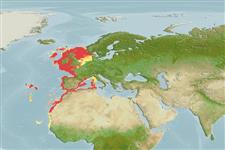
Eastern Atlantic: Norway south to Cape Lopez, Gabon and including Madeira, Azores and the Canary Islands. Also in the Mediterranean and Adriatic seas.
Größe / Gewicht / Alter
Geschlechtsreife: Lm ? range ? - ? cm
Max length : 25.0 cm TL Männchen/unbestimmt; (Ref. 5292)
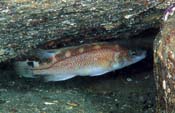
Dark spot on upper part of caudal peduncle and in the end of the spiny part of the dorsal fin (Ref. 35388).
Body shape (shape guide): fusiform / normal.
Adults inhabit coastal waters near rocky or sandy bottoms. Feed on benthic invertebrates. Solitary (Ref. 2683). Oviparous, distinct pairing during breeding (Ref. 205). Males build dish shaped nests and guard the eggs (Ref. 205).
Lebenszyklus und Paarungsverhalten
Geschlechtsreife | Fortpflanzung | Ablaichen | Eier | Fruchtbarkeit | Larven
Oviparous, distinct pairing during breeding (Ref. 205). Males build dish shaped nests and guard the eggs (Ref. 205).
Gomon, M.F. and P. Forsyth, 1990. Labridae. p. 868-882. In J.C. Quero, J.C. Hureau, C. Karrer, A. Post and L. Saldanha (eds.) Check-list of the fishes of the eastern tropical Atlantic (CLOFETA). JNICT, Lisbon, SEI, Paris; and UNESCO, Paris. Vol. 2. (Ref. 5292)
IUCN Rote Liste Status (Ref. 130435: Version 2025-2 (Global))
Bedrohung für Menschen
Harmless
Nutzung durch Menschen
Fischereien: kommerziell
Tools
Zusatzinformationen
Download XML
Internet Quellen
Schätzungen auf der Grundlage von Modellen
Bevorzugte Temperatur (Ref.
123201): 7.1 - 15.1, mean 9.9 °C (based on 356 cells).
Phylogenetischer Diversitätsindex (Ref.
82804): PD
50 = 1.0000 [Uniqueness, from 0.5 = low to 2.0 = high].
Bayesian length-weight: a=0.01023 (0.00569 - 0.01840), b=3.06 (2.90 - 3.22), in cm total length, based on LWR estimates for this species & (Sub)family-body (Ref.
93245).
Trophische Ebene (Ref.
69278): 3.5 ±0.37 se; based on food items.
Widerstandsfähigkeit (Ref.
120179): mittel, Verdopplung der Population dauert 1,4 - 4,4 Jahre. (Preliminary K or Fecundity.).
Anfälligkeit der Fischerei (Ref.
59153): Low vulnerability (15 of 100).
🛈
Nährstoffe (Ref.
124155): Calcium = 17.8 [8.1, 31.7] mg/100g; Iron = 0.211 [0.114, 0.440] mg/100g; Protein = 18.6 [15.7, 20.9] %; Omega3 = 0.494 [0.266, 0.917] g/100g; Selenium = 9.93 [4.54, 21.79] μg/100g; VitaminA = 75.5 [18.4, 368.0] μg/100g; Zinc = 0.662 [0.427, 1.175] mg/100g (wet weight);