>
Anguilliformes (Eels and morays) >
Colocongridae (Short-tail eels)
Etymology: Coloconger: Greek, kolos = short, truncated + Latin conger = conger (Ref. 45335).
Eponymy: Patrick Scholes (ca: 1946–2011) was Chief Scientist at the Ministry of Agriculture, Fisheries and Food Lowestoft Fisheries Laboratory, England. [...] (Ref. 128868), visit book page.
Umwelt: Milieu / Klimazone / Tiefenbereich / Verbreitungsgebiet
Ökologie
seewasser bathydemersal; tiefenbereich 412 - 970 m (Ref. 86942). Deep-water
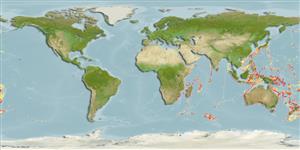
Indo-Pacific: southern Mozambique and Natal, South Africa, but probably much more widespread, also South China Sea and east Australia.
Größe / Gewicht / Alter
Geschlechtsreife: Lm ? range ? - ? cm
Max length : 51.0 cm TL Männchen/unbestimmt; (Ref. 5323)
Kurzbeschreibung
Bestimmungsschlüssel | Morphologie | Morphometrie
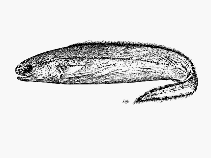
Wirbelzahl: 142 - 157. Dark blackish brown.
Body shape (shape guide): eel-like.
Inhabits deep waters (Ref. 5213).
Lebenszyklus und Paarungsverhalten
Geschlechtsreife | Fortpflanzung | Ablaichen | Eier | Fruchtbarkeit | Larven
Castle, P.H.J., 1986. Congridae. p. 161-165. In M.M. Smith and P.C. Heemstra (eds.) Smiths' sea fishes. Springer-Verlag, Berlin. (Ref. 5323)
IUCN Rote Liste Status (Ref. 130435: Version 2025-2 (Global))
Bedrohung für Menschen
Harmless
Nutzung durch Menschen
Fischereien: bycatch
Tools
Zusatzinformationen
Download XML
Internet Quellen
Schätzungen auf der Grundlage von Modellen
Bevorzugte Temperatur (Ref.
123201): 2.2 - 10.3, mean 7.8 °C (based on 421 cells).
Phylogenetischer Diversitätsindex (Ref.
82804): PD
50 = 0.5010 [Uniqueness, from 0.5 = low to 2.0 = high].
Bayesian length-weight: a=0.00110 (0.00043 - 0.00279), b=3.13 (2.91 - 3.35), in cm total length, based on LWR estimates for this (Sub)family-body shape (Ref.
93245).
Trophische Ebene (Ref.
69278): 3.8 ±0.6 se; based on size and trophs of closest relatives
Anfälligkeit der Fischerei (Ref.
59153): Moderate vulnerability (40 of 100).
🛈