>
Scombriformes (Mackerels) >
Gempylidae (Snake mackerels)
Etymology: Thyrsitoides: Greek, thyrsites, -ou = stalk of a plant, an ornament like a pine cone borne by Bacchus + Greek, oides = similar to (Ref. 45335).
Eponymy: Harold Walter Bell Marley (1872–1945) was Principal Fisheries Officer (1918–1937) at Durban, South Africa, and a naturalist with a particular interest in entomology. [...] (Ref. 128868), visit book page.
More on author: Fowler.
Lingkungan: lingkungan / zona iklim / kisaran kedalaman / jangkauan distribusi
Ekologi
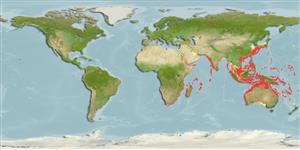
laut bentopelagis; kisaran kedalaman 0 - 400 m (Ref. 6181). Deep-water; 39°N - 44°S, 25°E - 134°W (Ref. 6181)
Indo-West Pacific: Red Sea to South Africa and New Caledonia, north to Japan. Recently reported from Tonga (Ref. 53797).
Ukuran / Berat / umur
Kematangan: Lm ? range ? - ? cm
Max length : 200 cm TL jantan/; (Ref. 4408); common length : 100.0 cm SL jantan/; (Ref. 9784)
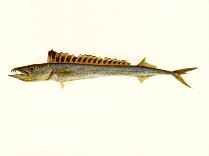
Duri punggung (Keseluruhan (total)) : 17 - 19; duri punggung lunak (Keseluruhan (total)) : 16 - 17; Duri dubur: 1; Sirip dubur lunak: 16 - 17; vertebrata, bertulang belakang: 34. Two lateral lines, originating above the upper angle of gill opening, branching below the 4th dorsal-fin spine or slightly behind it, upper line running along the first dorsal-fin base and ending below about the end of the first dorsal fin, lower line abruptly curved backward from bifurcation, running mid laterally to the base of the middle caudal-fin ray. Body color is dark brown with slightly metallic reflections, sometimes slightly paler on belly. Dorsal fin membranes with black markings.
Body shape (shape guide): elongated; Cross section: compressed.
Mesobenthopelagic, down to depths of 400 m or more, often at the surface at night around Okinawa, Japan (Ref. 6181). The largest populations are probably on the slope of seamounts or ridges (Ref. 6181). Feeds on a variety of mesopelagic fish, squid and crustaceans (Ref. 6181).
Nakamura, I. and N.V. Parin, 1993. FAO Species Catalogue. Vol. 15. Snake mackerels and cutlassfishes of the world (families Gempylidae and Trichiuridae). An annotated and illustrated catalogue of the snake mackerels, snoeks, escolars, gemfishes, sackfishes, domine, oilfish, cutlassfishes,. scabbardfishes, hairtails, and frostfishes known to date. FAO Fish. Synop. 125(15):136 p. (Ref. 6181)
Status IUCN Red List (Ref. 130435: Version 2025-2 (Global))
ancaman kepada manusia
Harmless
penggunaan manusia
Perikanan: nilai komersial kecil
Alat, peralatan
laporan khas
muat turun XML
Sumber internet
Estimasi berdasarkan model
Suhu yang disukai (Acuan
123201): 15.3 - 28, mean 23.7 °C (based on 1045 cells).
Indeks keanekaragaman filogenetik (Acuan
82804): PD
50 = 1.0000 [Uniqueness, from 0.5 = low to 2.0 = high].
Bayesian length-weight: a=0.00427 (0.00204 - 0.00890), b=3.16 (2.97 - 3.35), in cm total length, based on LWR estimates for this species & (Sub)family-body (Ref.
93245).
Tingkat Trofik (Acuan
69278): 4.2 ±0.58 se; based on food items.
Daya lenting (Acuan
120179): sangat rendah, Waktu penggandaan populasi minimum lebih dari 14 tahun (Preliminary K or Fecundity.).
Kerentanan Penangkapan Ikan (Ref.
59153): Very high vulnerability (90 of 100).
🛈