Milieu: milieu / Klimaatzone / Diepte / verspreidingsgebied
Ecologie
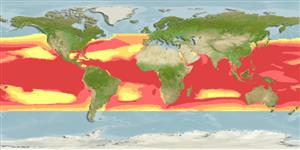
marien pelagic-oceanic; oceanodroom (Ref. 71039); diepte 0 - 200 m (Ref. 54238), usually 30 - ? m (Ref. 9688). Subtropical; 50°N - 43°S, 180°W - 180°E (Ref. 43)
Indo-Pacific: tropical and temperate waters approximately 45°- 50°N and 40°-35°S in the western Pacific, 35°N and 35°S in the eastern Pacific; 45°S in western Indian Ocean and 35°S in eastern Indian Ocean. Entered Mediterranean Sea from Red sea via Suez Canal. Highly migratory species. Some authors recognize a single worldwide species, Istiophorus platypterus (Shaw & Nodder 1792) but we follow Nakamura 1990 (Ref. 10820) retaining the usage of Istiophorus platypterus for the Indo-Pacific sailfish and Istiophorus albicans for the Atlantic sailfish in recognition of the differences between them.
Grootte / Gewicht / Leeftijd
Maturiteit: Lm ? range ? - 150 cm
Max length : 348 cm FL mannelijk / geslacht onbekend; (Ref. 40637); common length : 270 cm TL mannelijk / geslacht onbekend; (Ref. 9308); max. gepubliceerd gewicht: 100.2 kg (Ref. 40637); max. gerapporteerde leeftijd: 13 Jaren (Ref. 53742)
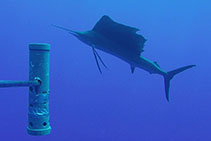
Dorsale stekels (totaal) : 0; Dorsale zachte stralen (totaal) : 47 - 53; Anale stekels: 2; Anale zachte stralen: 12 - 15. This species is distinguished by the following characters: slender elongate and fairly compressed with a high, sail-like first dorsal fin; upper jaw prolonged into a very long beak, slender and round in cross-section; jaws and palatines with villiform teeth; no gill rakers; two dorsal fins, the first very large (42-49 rays) the second small (6-7 rays); pectoral fins 18-20 rays; pelvic fins I, 2 soft rays fused together, very long and narrow, depressible into a groove; caudal peduncle with double keels on each side; body covered with small, embedded scales with 1 or 2 blunt points. Colour of back dark with about 20 bluish vertical bars; belly pale silver; membrane of first dorsal fin blue- black with numerous dark spots; bases of first and second anal fins often tinged with silvery white; remaining fins blackish brown or dark blue (Ref. 43, 26938).
Body shape (shape guide): elongated; Cross section: compressed.
Oceanic and epipelagic species usually found above the thermocline. Most densely distributed in waters close to coasts and islands (Ref. 9688). Most likely schools by size. Undergoes spawning migrations in the Pacific. Feeds mainly on fishes, crustaceans and cephalopods. Caught mainly with longlines, set nets, and sometimes by trolling and harpooning from boats (Ref. 43). Utilized fresh, smoked and frozen; also used for sashimi and sushi; eaten broiled and baked (Ref. 9987).
Seems to spawn throughout the year in tropical and subtropical waters of the Pacific with peak spawning occurring in the respective local summer seasons. Spawning occurs with males and females swimming in pairs or with two or three males chasing a single female (probably a mating behavior). The ripe ovarian eggs are about 0.85 mm in diameter and have a single oil globule; there are no structures on the vitalize membrane and the egg is transparent. Eggs shed from captured female in the Indian Ocean averaged 1.304 mm in diameter.
Nakamura, I., 1985. FAO species catalogue. Vol. 5. Billfishes of the world. An annotated and illustrated catalogue of marlins, sailfishes, spearfishes and swordfishes known to date. FAO Fish. Synop. 125(5):65p. Rome: FAO. (Ref. 43)
Status op de Rode Lijst van het IUCN (Ref. 130435: Version 2025-2 (Global))
Gevaar voor de mens
Harmless
Gebruik door de mens
Visserij: commercieel; sportvis: ja
Tools
Speciale rapporten
Download XML
Internetbronnen
Schattingen op basis van modellen
Gewenste temperatuur (Ref.
123201): 18.2 - 27.7, mean 25.6 °C (based on 513 cells).
Fylogenetische diversiteitsindex (Ref.
82804): PD
50 = 0.7505 [Uniqueness, from 0.5 = low to 2.0 = high].
Bayesian length-weight: a=0.00589 (0.00275 - 0.01263), b=3.14 (2.94 - 3.34), in cm total length, based on LWR estimates for this species & (Sub)family-body (Ref.
93245).
Trofisch niveau (Ref.
69278): 4.5 ±0.3 se; based on diet studies.
Weerstandsvermogen (Ref.
120179): laag, minimale populatieverdubbelingstijd 4,5-14 jaar (rm=0.11; K=0.1-0.8; tmax=13; Fec=>2M).
Prior r = 0.38, 95% CL = 0.25 - 0.57, Based on 1 full stock assessment.
Kwetsbaarheid van de visserij (Ref.
59153): Moderate vulnerability (41 of 100).
🛈
Kwetsbaarheid voor het klimaat (Ref.
125649): Moderate to high vulnerability (48 of 100).
🛈
Voedingsstoffen (Ref.
124155): Calcium = 26.2 [12.9, 42.4] mg/100g; Iron = 0.856 [0.511, 1.406] mg/100g; Protein = 19.6 [18.4, 20.6] %; Omega3 = 0.209 [0.114, 0.374] g/100g; Selenium = 44.7 [23.7, 83.1] μg/100g; VitaminA = 6.44 [2.15, 18.92] μg/100g; Zinc = 0.364 [0.257, 0.521] mg/100g (wet weight);