>
Centrarchiformes (Basses) >
Kuhliidae (Aholeholes)
Etymology: Kuhlia: Because of Heindrich Kuhl, 1797-1821; researcher also with lizards (Gekkonidae).
Eponymy: Dr Heinrich Kuhl (1797–1821) was a German naturalist and zoologist. [...] (Ref. 128868), visit book page.
More on author: Lacepède.
Milieu: milieu / Klimaatzone / Diepte / verspreidingsgebied
Ecologie
marien; zoet water; brak water rifbewoner; katadroom (Ref. 138274); diepte 0 - 5 m (Ref. 86942). Tropical; 20°C - 26°C (Ref. 2060)
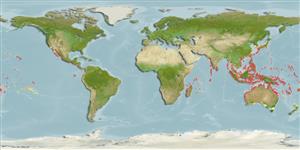
Africa to Asia and Oceania: East Africa to Samoa, north to the Ryukyu Islands, south to Queensland, Australia and New Caledonia.
Lengte bij maturiteit / Grootte / Gewicht / Leeftijd
Maturiteit: Lm 26.5, range 26 - 27 cm
Max length : 45.0 cm TL mannelijk / geslacht onbekend; (Ref. 5329); common length : 25.0 cm SL mannelijk / geslacht onbekend; (Ref. 2847); max. gepubliceerd gewicht: 2.7 kg (Ref. 5329)
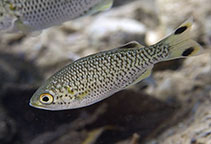
Dorsale stekels (totaal) : 10; Dorsale zachte stralen (totaal) : 10 - 12; Anale stekels: 3; Anale zachte stralen: 9 - 11. Diagnosis: Preorbital serrae 10-15 (obsolete in large specimens); body depth 2.6-3.0 in SL; mouth large for genus, maxilla reaching to below posterior half of eye; caudal fin emarginate, lobes somewhat rounded, caudal concavity 5.3-8.7 in head length (Ref. 41640). Reduced number of lateral line scales; 17-18(19) gillrakers on lower part of first bracnhial arch; body with spots (Ref. 79840).
Coloration: Silvery, the scales dorsally on body with black edges, those on side with a black bar or spot; juveniles with a broad black zone, edged above and below in white, in soft portion of dorsal fin, and each lobe of caudal fin with a large, white-edged black spot; black areas in these fins enlarge with growth until in adults most of these fins black (caudal with upper and lower edges and corners whitish) (Ref. 41640).
Body shape (shape guide): fusiform / normal.
Primarily a freshwater inhabitant but may penetrate adjacent marine habitats (Ref. 41640). Adults occur in estuaries and the middle reaches of rivers; usually in relatively fast-flowing, clear streams (Ref. 2847, 79840). Usually in rainforests, as well as in rocky pools below waterfalls (Ref. 44894). Adults are omnivorous, feeding on small fishes, insects, crustaceans and fruits (figs) that drop into the water. Specific breeding habits are unknown, but adults move downstream into estuaries or to the sea to spawn (Ref. 44894). Neither anterolateral groove nor venom gland is present (Ref. 57406). Good food fish (Ref. 5329).
Levenscyclus en paargedrag
Maturiteit | Voortplanting | Paaien | Eieren | Fecunditeit | Larven
Presumably non-guarders (RF).
Randall, J.E. and H.A. Randall, 2001. Review of the fishes of the genus Kuhlia (Perciformes: Kuhliidae) of the Central Pacific. Pac. Sci. 55(3):227-256. (Ref. 41640)
Status op de Rode Lijst van het IUCN (Ref. 130435: Version 2025-2 (Global))
Gevaar voor de mens
Harmless
Gebruik door de mens
Visserij: commercieel; sportvis: ja
Tools
Speciale rapporten
Download XML
Internetbronnen
Schattingen op basis van modellen
Gewenste temperatuur (Ref.
123201): 24.2 - 29.3, mean 28.4 °C (based on 2775 cells).
Fylogenetische diversiteitsindex (Ref.
82804): PD
50 = 0.5005 [Uniqueness, from 0.5 = low to 2.0 = high].
Bayesian length-weight: a=0.01413 (0.00597 - 0.03345), b=3.06 (2.86 - 3.26), in cm total length, based on LWR estimates for this (Sub)family-body shape (Ref.
93245).
Trofisch niveau (Ref.
69278): 3.2 ±0.45 se; based on food items.
Weerstandsvermogen (Ref.
120179): Gemiddeld, minimale populatieverdubbelingstijd 1,4-4,4 jaar (Preliminary K or Fecundity.).
Kwetsbaarheid van de visserij (Ref.
59153): Low to moderate vulnerability (35 of 100).
🛈
Voedingsstoffen (Ref.
124155): Calcium = 47.5 [26.2, 74.1] mg/100g; Iron = 0.537 [0.323, 0.863] mg/100g; Protein = 19.4 [18.3, 20.4] %; Omega3 = 0.111 [0.070, 0.175] g/100g; Selenium = 19.4 [11.2, 34.6] μg/100g; VitaminA = 80.8 [27.4, 245.9] μg/100g; Zinc = 1.58 [1.13, 2.15] mg/100g (wet weight);