Elasmobranchii (haaien en roggen) (sharks and rays) >
Carcharhiniformes (Ground sharks) >
Pentanchidae (Deepwater catsharks)
Etymology: Apristurus: a-, Latin privative, i.e., without; pristis, from pristes (Gr.), sawyer (but here meaning saw); oura (Gr.), tail, referring to absence of saw-toothed crest of enlarged dermal denticles along upper edge of caudal fin as found in the closely related Pristiurus (=Galeus) (See ETYFish); parvipinnis: parvus (L.), small; pinnis (L.), fin, referring to first dorsal fin 2-4 times smaller than second dorsal fin (See ETYFish).
Milieu: milieu / Klimaatzone / Diepte / verspreidingsgebied
Ecologie
marien bathydemersaal; diepte 600 - 1380 m (Ref. 44037). Deep-water; 30°N - 6°N
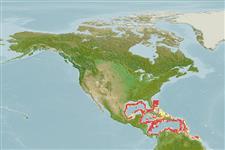
Western Atlantic: northeastern Gulf of Mexico off Florida, Gulf of Campeche, Panama, Colombia, and off French Guiana. Had been originally termed Apristurus indicus by Springer (1966) but apparently not conspecific with the Indian Ocean species.
Grootte / Gewicht / Leeftijd
Maturiteit: Lm ? range ? - ? cm
Max length : 48.0 cm TL mannelijk / geslacht onbekend; (Ref. 244); 52.0 cm TL (female)
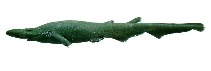
Second dorsal fin distinctly larger than the first (Ref. 13608).
Body shape (shape guide): elongated.
Found on the continental slope. Oviparous, apparently laying one egg per oviduct at a time. The most common Apristurus species in the Gulf of Mexico, along with A. laurussonii.
Levenscyclus en paargedrag
Maturiteit | Voortplanting | Paaien | Eieren | Fecunditeit | Larven
Oviparous, paired eggs are laid. Embryos feed solely on yolk (Ref. 50449).
Compagno, L.J.V., 1984. FAO Species Catalogue. Vol. 4. Sharks of the world. An annotated and illustrated catalogue of shark species known to date. Part 2 - Carcharhiniformes. FAO Fish. Synop. 125(4/2):251-655. Rome: FAO. (Ref. 244)
Status op de Rode Lijst van het IUCN (Ref. 130435: Version 2025-2 (Global))
Gevaar voor de mens
Harmless
Gebruik door de mens
Visserij: visserij voor eigen gebruik
Tools
Speciale rapporten
Download XML
Internetbronnen
Schattingen op basis van modellen
Gewenste temperatuur (Ref.
123201): 5.2 - 10.4, mean 6.4 °C (based on 83 cells).
Fylogenetische diversiteitsindex (Ref.
82804): PD
50 = 0.5000 [Uniqueness, from 0.5 = low to 2.0 = high].
Bayesian length-weight: a=0.00347 (0.00172 - 0.00698), b=3.08 (2.90 - 3.26), in cm total length, based on LWR estimates for this (Sub)family-body shape (Ref.
93245).
Trofisch niveau (Ref.
69278): 3.9 ±0.6 se; based on size and trophs of closest relatives
Weerstandsvermogen (Ref.
120179): Zeer laag, minimale populatieverdubbelingstijd meer dan 14 jaar (Fec assumed to be <10).
Kwetsbaarheid van de visserij (Ref.
59153): Moderate vulnerability (41 of 100).
🛈