>
Acanthuriformes (Surgeonfishes) >
Pomacanthidae (Angelfishes)
Etymology: Centropyge: Greek, kentron = sting + Greek, pyge = tail (Ref. 45335).
Eponymy: Frederic A Potter was the first Director (1904–1940) of the Honolulu Aquarium (now the Waikiki Aquarium). [...] (Ref. 128868), visit book page.
More on authors: Jordan & Metz.
Milieu: milieu / Klimaatzone / Diepte / verspreidingsgebied
Ecologie
marien rifbewoner; standvastig (Ref. 52884); diepte 5 - 138 m (Ref. 58302), usually 10 - ? m (Ref. 9710). Tropical; 30°N - 17°N
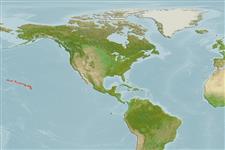
Eastern Central Pacific: Johnston (Ref. 11013) and Hawaiian Islands.
Grootte / Gewicht / Leeftijd
Maturiteit: Lm ? range ? - ? cm
Max length : 12.5 cm TL mannelijk / geslacht onbekend; (Ref. 30504)
Korte beschrijving
Determinatiesleutels | Morfologie | Morfometrie
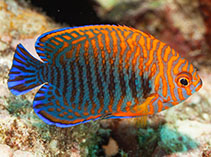
Bright orange with irregular, close-set, thin, vertical black stripes on body, head, and fins; the dorsal, caudal, and anal fins with bright blue margin; the pectoral and pelvic fins orange to bright yellow.
Body shape (shape guide): short and / or deep; Cross section: compressed.
Adults inhabit rock, coral, or rubble areas of seaward reefs; juveniles occasionally in 5 m (Ref. 9710). Benthopelagic (Ref. 58302). Feed on algae and detritus (Ref. 13550). Oviparous (Ref. 240). Monogamous and always in home-ranging pairs, that is they do not defend an exclusive territory (Ref. 52884). Peak reproductive activity occurs from mid-December through May. Spawn at dusk during the week before full moon (Ref. 4858).
Levenscyclus en paargedrag
Maturiteit | Voortplanting | Paaien | Eieren | Fecunditeit | Larven
Pelagic spawner. Distinct pairing (Ref. 240). Monogamous mating is observed as both facultative and social (Ref. 52884).
Allen, G.R., 1985. Butterfly and angelfishes of the world. Vol. 2. 3rd edit. in English. Mergus Publishers, Melle, Germany. (Ref. 4858)
Status op de Rode Lijst van het IUCN (Ref. 130435: Version 2025-2 (Global))
Gevaar voor de mens
Harmless
Gebruik door de mens
Visserij: commercieel; Aquarium: Commercieel
Tools
Speciale rapporten
Download XML
Internetbronnen
Schattingen op basis van modellen
Gewenste temperatuur (Ref.
123201): 8.8 - 25.5, mean 20.2 °C (based on 6 cells).
Fylogenetische diversiteitsindex (Ref.
82804): PD
50 = 0.5000 [Uniqueness, from 0.5 = low to 2.0 = high].
Bayesian length-weight: a=0.03020 (0.01316 - 0.06929), b=2.89 (2.70 - 3.08), in cm total length, based on LWR estimates for this (Sub)family-body shape (Ref.
93245).
Trofisch niveau (Ref.
69278): 2.6 ±0.26 se; based on food items.
Weerstandsvermogen (Ref.
120179): Hoog, minimale populatieverdubbelingstijd minder dan 15 maanden (Preliminary K or Fecundity.).
Kwetsbaarheid van de visserij (Ref.
59153): Low vulnerability (10 of 100).
🛈
Voedingsstoffen (Ref.
124155): Calcium = 103 [48, 158] mg/100g; Iron = 0.724 [0.443, 1.224] mg/100g; Protein = 18 [17, 19] %; Omega3 = 0.133 [0.078, 0.219] g/100g; Selenium = 31.6 [16.3, 60.2] μg/100g; VitaminA = 97.9 [25.2, 367.3] μg/100g; Zinc = 1.76 [1.19, 2.55] mg/100g (wet weight);