>
Blenniiformes (Blennies) >
Blenniidae (Combtooth blennies) > Blenniinae
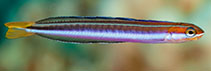
Etymology: Plagiotremus: Greek, plagios = oblique + Greek, trema = hole (Ref. 45335); goslinei: Named for Dr. William A. Gosline of the University of Hawaii.
Eponymy: Dr William Alonzo Gosline (1915–2002) was an ichthyologist and botanist at the University of Michigan. [...] (Ref. 128868), visit book page.
Environnement : milieu / zone climatique / profondeur / gamme de distribution
Écologie
marin récifal; profondeur 1 - 15 m (Ref. 58302). Tropical
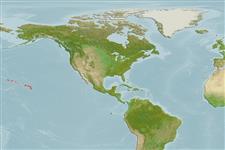
Eastern Central Pacific: Hawaiian Islands.
Taille / Poids / Âge
Maturité: Lm ? range ? - ? cm
Max length : 6.4 cm SL mâle / non sexé; (Ref. 3921)
Description synthétique
Clés d'identification | Morphologie | Morphométrie
Épines dorsales (Total) : 11 - 12; Rayons mous dorsaux (Total) : 23 - 26; Épines anales: 3; Rayons mous anaux: 20 - 21.
Body shape (shape guide): elongated; Cross section: compressed.
Adults are benthic or benthopelagic in or over coral (Ref. 58302). Common from the shallow waters to about 15 m. Taken with rotenone at 3-5 feet along rocky seashores where there was some sand bottom and where water circulation was good. Some specimens were collected from the stomachs of large fish (e.g. yellowfin tuna, Neothunnus macropterus) and from dolphins (Coryphaena hippurus) (Ref. 643). Oviparous. Eggs are demersal and adhesive (Ref. 205), and are attached to the substrate via a filamentous, adhesive pad or pedestal (Ref. 94114). Larvae are planktonic, often found in shallow, coastal waters (Ref. 94114).
Cycle de vie et comportement reproducteur
Maturité | Reproduction | Frai | Œufs | Fécondité | Larves
Oviparous, distinct pairing (Ref. 205).
Randall, J.E., 1985. Guide to Hawaiian reef fishes. Harrowood Books, Newtown Square, PA 19073, USA. 74 p. (Ref. 3921)
Statut dans la liste rouge de l'IUCN (Ref. 130435: Version 2025-2 (Global))
Menace pour l'homme
Harmless
Utilisations par l'homme
Pêcheries: commercial; Aquarium: Commercial
Outils
Articles particuliers
Télécharger en XML
Sources Internet
Estimations basées sur des modèles
Température préférée (Réf.
123201): 24.8 - 28.4, mean 25.4 °C (based on 36 cells).
Indice de diversité phylogénétique (Réf.
82804): PD
50 = 0.5005 [Uniqueness, from 0.5 = low to 2.0 = high].
Bayesian length-weight: a=0.00575 (0.00255 - 0.01297), b=3.06 (2.87 - 3.25), in cm total length, based on LWR estimates for this (Sub)family-body shape (Ref.
93245).
Niveau trophique (Réf.
69278): 4.0 ±0.7 se; based on size and trophs of closest relatives
Résilience (Réf.
120179): Haut, temps minimum de doublement de population inférieur à 15 mois (Preliminary K or Fecundity.).
Vulnérabilité de la pêche (Ref.
59153): Low vulnerability (10 of 100).
🛈
Nutriments (Ref.
124155): Calcium = 183 [92, 342] mg/100g; Iron = 0.968 [0.544, 1.654] mg/100g; Protein = 18.3 [17.2, 19.4] %; Omega3 = 0.108 [0.055, 0.206] g/100g; Selenium = 19.1 [8.7, 45.1] μg/100g; VitaminA = 285 [96, 839] μg/100g; Zinc = 1.95 [1.24, 2.91] mg/100g (wet weight);