>
Perciformes/Bembropoidei (Duckbill flatheads) >
Bembropidae (Duckbill flatheads)
Etymology: Bembrops: Greek, bembras, -ados = a kind of anchovy m+ Greek, ops = appearance (Ref. 45335); platyrhynchus: Specific name from the Greek 'platys' meaning flat and 'rhynchos' meaning snout or beak.
More on author: Alcock.
Taxonomic Remarks
Hoese and Bray (2006: in Ref. 75154) reccognize Bembrops philippinus as valid. It seems no new information has been published since under that name, or under Bembrops platyrhynchus.in the Philippines. Please send papers we missed, or more studies are needed.
Ambiente: milieu / zona climatica / distribuzione batimetrica / gamma di distribuzione
Ecologia
marino batidemersale; distribuzione batimetrica 200 - 549 m (Ref. 26165). Deep-water
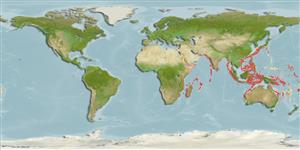
Indo-West Pacific: including the Bay of Bengal, the South China Sea, the Philippine Sea, the Tasman Sea, and off the coast of Somalia and South Africa.
Dimensione / Peso / Età
Maturità: Lm ? range ? - ? cm
Max length : 25.0 cm TL maschio/sesso non determinato; (Ref. 6652)
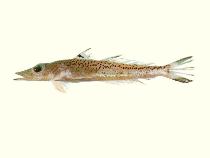
Spine dorsali (totale) : 6; Raggi dorsali molli (totale) : 14 - 15; Spine anali: 0; Raggi anali molli: 15 - 16. Vague dusky spots along body, 1 on caudal fin at base of upper rays; scales edged with black; 1st dorsal fin dusky to black in color (Ref. 6652). Distal margin of first dorsal fin darkish. Usually 5 scale rows between lateral line and origin of anal fin (Ref 12932).
Body shape (shape guide): elongated.
Inhabits offshore trawling grounds (Ref. 3132).
Ciclo vitale e comportamento di accoppiamento
Maturità | Riproduzione | Deposizione | Uova | Fecondità | Larve
Das, M.K. and J.S. Nelson, 1996. Revision of the percophid genus Bembrops (Actinopterygii: Perciformes). Bull. Mar. Sci. 59(1):9-44. (Ref. 13203)
Stato della Lista Rossa IUCN (Ref. 130435: Version 2025-2 (Global))
Minaccia per l'uomo
Harmless
Usi umani
Strumenti
Rapporti speciali
Scarica XML
Fonti Internet
Stime basate su modelli
Temperatura preferita (Fonte Biblio.
123201): 9.8 - 17.3, mean 12.5 °C (based on 197 cells).
Indice di diversità filogenetica (Fonte Biblio.
82804): PD
50 = 0.5000 [Uniqueness, from 0.5 = low to 2.0 = high].
Bayesian length-weight: a=0.00363 (0.00176 - 0.00751), b=3.13 (2.95 - 3.31), in cm total length, based on LWR estimates for this species & (Sub)family-body (Ref.
93245).
Livello trofico (Fonte Biblio.
69278): 4.1 ±0.5 se; based on size and trophs of closest relatives
Vulnerabilità della pesca (Ref.
59153): Low vulnerability (15 of 100).
🛈