>
Carangaria/misc (Various families in series Carangaria) >
Polynemidae (Threadfins)
Etymology: Polydactylus: Greek, poly = a lot of + greek, daktylos = finger (Ref. 45335).
Taxonomic Remarks
Genus Eschmeyer, pers. comm.
Ambiente: milieu / zona climatica / distribuzione batimetrica / gamma di distribuzione
Ecologia
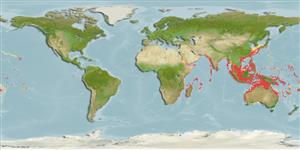
marino; salmastro demersale; distribuzione batimetrica ? - 122 m (Ref. 57343). Tropical; 37°N - 35°S, 22°E - 148°W (Ref. 57343)
Indo-Pacific: East Africa to French Polynesia, north to Japan, south to Australia. Has not been collected from the Red Sea or Persian Gulf (Ref. 57343).
Dimensione / Peso / Età
Maturità: Lm ? range ? - ? cm
Max length : 45.0 cm SL maschio/sesso non determinato; (Ref. 57343); common length : 30.0 cm TL maschio/sesso non determinato; (Ref. 30573); peso massimo pubblicato: 1.7 kg (Ref. 40637)
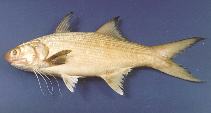
Spine dorsali (totale) : 9; Raggi dorsali molli (totale) : 13; Spine anali: 2; Raggi anali molli: 11 - 12. Golden, dusky olive brown above, scale rows each with a dark line; fins dusky (Ref. 5492). Body with 7 or 8 prominent dark stripes along the longitudinal scale rows above lateral line and 7-9 faint stripes below. Pectoral fin rays unbranched; 4th or 5th pectoral filament longest, 22-40% of SL. Posterior margin of maxilla reaching to (or slightly extending beyond) level of posterior margin of adipose eyelid. Lower tip of 7th proximal pterygiophore of 1st dorsal fin directed backwards. Lateral squamation on caudal fin unbranched (Ref. 40970).
Body shape (shape guide): elongated.
Occur over muddy bottoms of the continental shelf (Ref. 4340), from estuaries to coastal beaches and to relatively deep waters (less than 122 m) (Ref. 57343). Forms loosely-associated schools (Ref. 57343). Feeds on small crustaceans, fishes and other benthic organisms (Ref. 30573). Fish of 12 cm can be caught in large numbers (Ref. 9685).
Ciclo vitale e comportamento di accoppiamento
Maturità | Riproduzione | Deposizione | Uova | Fecondità | Larve
Motomura, H., 2004. Threadfins of the world (Family Polynemidae). An annotated and illustrated catalogue of polynemid species known to date. FAO Spec. Cat. Fish. Purp. Rome: FAO. 3:117 p. (Ref. 57343)
Stato della Lista Rossa IUCN (Ref. 130435: Version 2025-2 (Global))
Minaccia per l'uomo
Harmless
Usi umani
Pesca: commerciale; Acquacoltura: commerciale; Pesce da pesca sportiva: si
Strumenti
Rapporti speciali
Scarica XML
Fonti Internet
Stime basate su modelli
Temperatura preferita (Fonte Biblio.
123201): 23.5 - 29.1, mean 28 °C (based on 2216 cells).
Indice di diversità filogenetica (Fonte Biblio.
82804): PD
50 = 0.5000 [Uniqueness, from 0.5 = low to 2.0 = high].
Bayesian length-weight: a=0.00832 (0.00480 - 0.01443), b=3.08 (2.92 - 3.24), in cm total length, based on LWR estimates for this species & (Sub)family-body (Ref.
93245).
Livello trofico (Fonte Biblio.
69278): 3.6 ±0.50 se; based on food items.
Resilienza (Fonte Biblio.
120179): Alto, tempo minimo di raddoppiamento della popolazione meno di 15 mesi (Preliminary K or Fecundity.).
Vulnerabilità della pesca (Ref.
59153): Moderate vulnerability (42 of 100).
🛈
Nutrienti (Ref.
124155): Calcium = 144 [72, 248] mg/100g; Iron = 0.946 [0.479, 1.674] mg/100g; Protein = 18.9 [17.4, 20.5] %; Omega3 = 0.173 [0.101, 0.293] g/100g; Selenium = 67.4 [36.1, 134.0] μg/100g; VitaminA = 15 [7, 31] μg/100g; Zinc = 1.27 [0.89, 1.82] mg/100g (wet weight);