>
Eupercaria/misc (Various families in series Eupercaria) >
Lutjanidae (Snappers) > Lutjaninae
Etymology: Lutjanus: Malay, ikan lutjan, name of a fish.
Eponymy: Dr Christian Gottfried Ehrenberg (1795–1876) was a German naturalist, comparative anatomist and microscopist; one of the foremost scientists of his time. [...] (Ref. 128868), visit book page.
More on author: Peters.
Entorno: milieu / zona climática / rango de profundidad / gama de distribución
Ecología
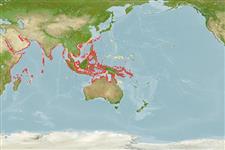
marino; agua dulce; salobre asociado a arrecife; rango de profundidad 5 - 20 m (Ref. 9710). Tropical; 30°N - 18°S, 31°E - 165°E (Ref. 55)
Indo-West Pacific: Red Sea and East Africa to the Solomon and Mariana islands.
Longitud en la primera madurez / Tamaño / Peso / Edad
Madurez: Lm 20.1, range 12 - ? cm
Max length : 35.0 cm TL macho / no sexado; (Ref. 55); common length : 20.0 cm TL macho / no sexado; (Ref. 55); edad máxima reportada: 12 años (Ref. 92948)
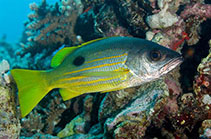
Espinas dorsales (total) : 10; Radios blandos dorsales (total) : 13 - 14; Espinas anales: 3; Radios blandos anales: 7 - 9. This species is distinguished by the following characters: body moderately deep; greatest depth 2.5-3.0 in SL; preopercular notch and knob poorly developed; vomerine tooth patch triangular, with a medial posterior extension; gill rakers of first gill arch 6-7 + 10-14 - 16-21; caudal fin truncate to slightly emarginate; scale rows on back parallel to lateral line. Colour of back and upper sides dark brown, lower sides and belly whitish with a silver sheen; usually a series of 4-5 narrow yellow stripes on the sides below the lateral line; a distinct round, black spot on the back below the posterior part of the spinous portion of the dorsal fin (Ref. 9821, 90102).
Body shape (shape guide): fusiform / normal; Cross section: oval.
Adults inhabit very shallow coastal habitats, often in large schools near freshwater run-offs (Ref. 48635). Juveniles often intertidal (Ref. 48635); over sand, silt, or coral rubble bottoms, occasionally in mangrove-lined streams and estuaries (Ref. 9821) They may enter freshwater to feed (Ref. 245); on small fish and invertebrates (Ref. 5213). This is a small species commonly utilized in subsistence fisheries and also seen in markets. Caught mainly with handlines, traps, and gill nets and are marketed mostly fresh (Ref. 9821).
Ciclo vital y comportamiento de apareamiento
Madurez | Reproducción | Puesta | Huevos | Fecundidad | Larva
Allen, G.R., 1985. FAO Species Catalogue. Vol. 6. Snappers of the world. An annotated and illustrated catalogue of lutjanid species known to date. FAO Fish. Synop. 125(6):208 p. Rome: FAO. (Ref. 55)
Situación en la Lista Roja de la UICN (Ref. 130435: Version 2025-2 (Global))
Amenaza para el ser humano
Harmless
Usos humanos
Pesquerías: escaso valor comercial
Herramientas
Informes especiales
Descargar XML
Fuentes de Internet
Estimaciones basadas en modelos
Temperatura preferida (Referencia
123201): 25.9 - 29.3, mean 28.6 °C (based on 2891 cells).
Índice de diversidad filogenética (Referencia
82804): PD
50 = 0.5000 [Uniqueness, from 0.5 = low to 2.0 = high].
Bayesian length-weight: a=0.01479 (0.01303 - 0.01679), b=2.96 (2.94 - 2.98), in cm total length, based on LWR estimates for this species (Ref.
93245).
Nivel trófico (Referencia
69278): 3.6 ±0.53 se; based on food items.
Generation time: 4.4 ( na - na) years. Estimated as median ln(3)/K based on 2
growth studies.
Resiliencia (Referencia
120179): Bajo, población duplicada en un tiempo mínimo de 4.5-14 años (K=0.24-0.9; tmax=12; tm=1.7).
Vulnerabilidad pesquera (Ref.
59153): Low vulnerability (19 of 100).
🛈
Nutrientes (Ref.
124155): Calcium = 56.1 [33.6, 96.4] mg/100g; Iron = 0.49 [0.30, 0.85] mg/100g; Protein = 18.8 [17.3, 20.2] %; Omega3 = 0.137 [0.085, 0.225] g/100g; Selenium = 51 [28, 92] μg/100g; VitaminA = 153 [28, 664] μg/100g; Zinc = 0.563 [0.396, 0.837] mg/100g (wet weight);