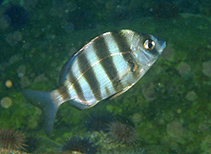
Klassifizierung / Names
Namen | Synonyme | Catalog of Fishes(Gattung, Arten) | ITIS | CoL | WoRMS | Cloffa
>
Eupercaria/misc (Various families in series Eupercaria) >
Sparidae (Porgies)
Etymology: Diplodus: Greek, diploos = twice + Greek, odous = teeth (Ref. 45335).
Taxonomic Remarks
Issue on validity of subspecies: subspecies considered as valid in FB, elevated to species rank as Diplodus hottentotus (Smith, 1844) in Eschmeyer (CofF ver. Mar. 2011: Ref. 86697). Please send references, or more studies are needed.
Umwelt: Milieu / Klimazone / Tiefenbereich / Verbreitungsgebiet
Ökologie
seewasser; brackwasser demersal; tiefenbereich ? - 100 m. Subtropical
Western Indian Ocean: known only from southern Mozambique and South Africa.
Länge bei der ersten Reifung / Größe / Gewicht / Alter
Geschlechtsreife: Lm 28.0 range ? - ? cm
Max length : 60.0 cm TL Männchen/unbestimmt; (Ref. 3507); common length : 30.0 cm TL Männchen/unbestimmt; (Ref. 3507); max. veröff. Alter: 33 Jahre (Ref. 26244)
Rückenflossenstacheln (insgesamt) : 11; Rückenflossenweichstrahlen (insgesamt) : 12 - 14; Afterflossenstacheln: 3; Afterflossenweichstrahlen: 11. Young bright yellow between crossbars.
Body shape (shape guide): fusiform / normal.
Inhabits coastal waters, mainly on rocky bottoms. Also enters estuaries, which are also used as nursery grounds. Feeds on fish, mollusks, crustaceans, worms, and other organisms. Has a nauseating odor; sold fresh in markets.
Lebenszyklus und Paarungsverhalten
Geschlechtsreife | Fortpflanzung | Ablaichen | Eier | Fruchtbarkeit | Larven
Heemstra, P.C. and E. Heemstra, 2004. Coastal fishes of Southern Africa. National Inquiry Service Centre (NISC) and South African Institute for Aquatic Biodiversity (SAIAB), Grahamstown. 488 p. (Ref. 58304)
IUCN Rote Liste Status (Ref. 130435: Version 2025-2 (Global))
Bedrohung für Menschen
Harmless
Nutzung durch Menschen
Fischereien: kommerziell; Sportfisch: ja
Tools
Zusatzinformationen
Download XML
Internet Quellen
Schätzungen auf der Grundlage von Modellen
Phylogenetischer Diversitätsindex (Ref.
82804): PD
50 = 0.5000 [Uniqueness, from 0.5 = low to 2.0 = high].
Bayesian length-weight: a=0.01288 (0.00806 - 0.02060), b=3.05 (2.92 - 3.18), in cm total length, based on LWR estimates for this species & Genus-body shape (Ref.
93245).
Trophische Ebene (Ref.
69278): 3.6 ±0.53 se; based on food items.
Generation time: 12.1 ( na - na) years. Estimated as median ln(3)/K based on 2
growth studies.
Widerstandsfähigkeit (Ref.
120179): niedrig, Verdopplung der Population dauert 4,5 - 14 Jahre. (tm=6; tmax=33).
Anfälligkeit der Fischerei (Ref.
59153): High to very high vulnerability (68 of 100).
🛈