>
Eupercaria/misc (Various families in series Eupercaria) >
Sparidae (Porgies)
Etymology: Polysteganus: Greek, polys = a lot of + Greek, stego, stege = covered (Ref. 45335).
More on author: Klunzinger.
Milieu: milieu / Klimaatzone / Diepte / verspreidingsgebied
Ecologie
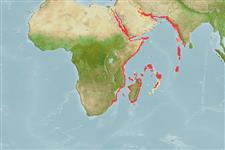
marien rifbewoner; diepte ? - 500 m (Ref. 100719). Tropical; 31°N - 28°S
Western Indian Ocean aand East Africa: including the Red Sea and probably Kenya.
Grootte / Gewicht / Leeftijd
Maturiteit: Lm ? range ? - ? cm
Max length : 60.0 cm TL mannelijk / geslacht onbekend; (Ref. 3198); common length : 35.0 cm TL mannelijk / geslacht onbekend; (Ref. 30573)
Korte beschrijving
Determinatiesleutels | Morfologie | Morfometrie
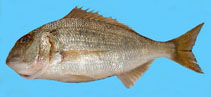
Dorsale stekels (totaal) : 12; Dorsale zachte stralen (totaal) : 10; Anale stekels: 3; Anale zachte stralen: 8. This species is distinguished from its congeners by the following set of characters: scale rows above lateral line 6½; scales rows between 5th dorsal-fin spine base and lateral-line scale 5½ or 6½; pored lateral-line scales 51 or 52; suborbital depth subequal to or greater than the orbit diameter; dorsal-fin rays are reddish pink as well as similar reddish pink on upper margin dorsal-fin ray (no clear yellow or faint yellowish); body with 7 or 8 faint irregular blue spotted lines, not visible from all angles; reddish membranes on caudal-fin lobes and caudal fin with clear white lowest margin of lower caudal fin lobe; without blue iridescence on each scale of dorsal and lateral sides of whitish pink body; canines are large, both upper and lower canines on both jaws usually visible even when mouth closed; body deep 44-46% (mean 44%) of SL; anal- and pelvic- fin rays are whitish or reddish hyaline; no yellow (white) rear margin of branchiostegal rays and membrane; weak bony bulge present before and above eye, forming a low median ridge in larger specimens of over 30 cm SL; caudal fin is moderately forked (Ref. 106993).
Body shape (shape guide): fusiform / normal; Cross section: compressed.
Occurs mainly in deep waters around reefs (Ref. 30573). Carnivorous predator (Ref. 30573). Sold fresh in markets.
Levenscyclus en paargedrag
Maturiteit | Voortplanting | Paaien | Eieren | Fecunditeit | Larven
Bauchot, M.-L. and M.M. Smith, 1984. Sparidae. In W. Fischer and G. Bianchi (eds.) FAO species identification sheets for fishery purposes. Western Indian Ocean (Fishing Area 51). volume 4. [var. pag.] FAO, Rome. (Ref. 3507)
Status op de Rode Lijst van het IUCN (Ref. 130435: Version 2025-2 (Global))
Gevaar voor de mens
Harmless
Gebruik door de mens
Visserij: commercieel
Tools
Speciale rapporten
Download XML
Internetbronnen
Schattingen op basis van modellen
Gewenste temperatuur (Ref.
123201): 14.2 - 24.7, mean 20.5 °C (based on 105 cells).
Fylogenetische diversiteitsindex (Ref.
82804): PD
50 = 0.5039 [Uniqueness, from 0.5 = low to 2.0 = high].
Bayesian length-weight: a=0.01259 (0.00603 - 0.02627), b=3.03 (2.86 - 3.20), in cm total length, based on LWR estimates for this (Sub)family-body shape (Ref.
93245).
Trofisch niveau (Ref.
69278): 4.1 ±0.7 se; based on size and trophs of closest relatives
Weerstandsvermogen (Ref.
120179): laag, minimale populatieverdubbelingstijd 4,5-14 jaar (Preliminary K or Fecundity.).
Kwetsbaarheid van de visserij (Ref.
59153): Moderate vulnerability (44 of 100).
🛈