Elasmobranchii (Haie und Rochen) (sharks and rays) >
Rajiformes (Skates and rays) >
Rajidae (Skates)
Etymology: Dipturus: Greek, di = two + Greek, pteryx = fin (Ref. 45335).
More on author: Smith.
Umwelt: Milieu / Klimazone / Tiefenbereich / Verbreitungsgebiet
Ökologie
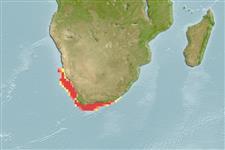
seewasser demersal; tiefenbereich 50 - 457 m (Ref. 5578). Subtropical; 26°S - 36°S, 12°E - 29°E (Ref. 114953)
Southeast Atlantic: known only from Lüderitz, Namibia to Port Alfred, Eastern Cape (South Africa)
Größe / Gewicht / Alter
Geschlechtsreife: Lm ? range ? - ? cm
Max length : 130 cm TL Männchen/unbestimmt; (Ref. 114953)
Kurzbeschreibung
Bestimmungsschlüssel | Morphologie | Morphometrie
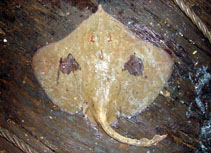
A striking two-toned longnose skate, medium brown above and abruptly dark grey below, with a large, conspicuous, dark brown blotch on the upper base of each pectoral fin (Ref. 5578). Snout moderately elongated and bluntly triangular, and tail stout, not conspicuously swollen and about equal to body length; pectoral disc with broadly rounded corners and smooth underside without denticles; thorns at nape and along midline of back and tail to 1st dorsal fin, nape spine enormous in young (Ref. 5578). Hatchlings and juveniles with wide-spaced black spots on upper disc, inconspicuous or lost in adolescents and adults; adults sometimes with numerous small white spots (Ref. 5578). Underside with numerous black pores (Ref. 5578).
Body shape (shape guide): other.
Found on soft bottoms of the outer shelf and upper slope (Ref. 5578). Feeds on bony fish, crabs, shrimp, mysids, mantis shrimp, euphausiids, bivalves and cuttlefish (Ref. 5578). Oviparous (Ref. 50449). Eggs have horn-like projections on the shell (Ref. 205). Males reaches maturity at 88-96 cm TL, females possibly slightly larger off Western than Southern coast of South Africa; hatching size at ca. 19 cm TL (Ref. 114953). Commonly taken by hake trawlers (Ref. 5578). Extremely slippery when caught (Ref. 5578).
Lebenszyklus und Paarungsverhalten
Geschlechtsreife | Fortpflanzung | Ablaichen | Eier | Fruchtbarkeit | Larven
Oviparous, paired eggs are laid. Embryos feed solely on yolk (Ref. 50449). Eggs have horn-like projections on the shell (Ref. 205).
McEachran, J.D. and K.A. Dunn, 1998. Phylogenetic analysis of skates, a morphologically conservative clade of elasmobranchs (Chondrichthyes: Rajidae). Copeia 1998(2):271-290. (Ref. 27314)
IUCN Rote Liste Status (Ref. 130435: Version 2025-2 (Global))
Bedrohung für Menschen
Harmless
Nutzung durch Menschen
Fischereien: nicht kommerziell
Tools
Zusatzinformationen
Download XML
Internet Quellen
Schätzungen auf der Grundlage von Modellen
Bevorzugte Temperatur (Ref.
123201): 9.2 - 16.7, mean 11 °C (based on 41 cells).
Phylogenetischer Diversitätsindex (Ref.
82804): PD
50 = 0.5000 [Uniqueness, from 0.5 = low to 2.0 = high].
Bayesian length-weight: a=0.00380 (0.00255 - 0.00567), b=3.19 (3.07 - 3.31), in cm total length, based on LWR estimates for this species & Genus-body shape (Ref.
93245).
Trophische Ebene (Ref.
69278): 4.1 ±0.69 se; based on food items.
Generation time: 22.0 ( na - na) years. Estimated as median ln(3)/K based on 2
growth studies.
Widerstandsfähigkeit (Ref.
120179): niedrig, Verdopplung der Population dauert 4,5 - 14 Jahre. (Fec assumed to be <100).
Anfälligkeit der Fischerei (Ref.
59153): Very high vulnerability (75 of 100).
🛈