>
Eupercaria/misc (Various families in series Eupercaria) >
Sillaginidae (Smelt-whitings)
Etymology: Sillago: From a locality in Australia.
Eponymy: Richard Moritz Schomburgk (1811–1891) was a gardener and botanist, who accompanied his brother Robert (see above) during his second expedition to Guiana and Venezuela. [...] (Ref. 128868), visit book page.
More on author: Peters.
Entorno: milieu / zona climática / rango de profundidad / gama de distribución
Ecología
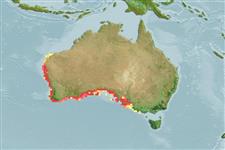
marino; salobre demersal; no migratorio; rango de profundidad 0 - 30 m (Ref. 6205), usually 0 - 2 m (Ref. 27657). Temperate; 21°S - 39°S, 111°E - 142°E (Ref. 6205)
Eastern Indian Ocean: endemic to Australia, from Dampier to Albany in Western Australia and Gulf St Vincent and Spencer Gulf waters in South Australia. It is not known whether they also occur in the intervening waters.
Longitud en la primera madurez / Tamaño / Peso / Edad
Madurez: Lm 22.5 range ? - ? cm
Max length : 42.0 cm TL macho / no sexado; (Ref. 27296); edad máxima reportada: 12 años (Ref. 27008)
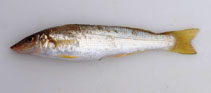
Espinas dorsales (total) : 11 - 13; Radios blandos dorsales (total) : 19 - 22; Espinas anales: 2; Radios blandos anales: 17 - 20; Vértebra: 37. Its swim bladder is without a median anterior extension.
Body shape (shape guide): elongated; Cross section: circular.
Generally frequent inshore sand banks, bars, and spits, and congregate in sandy hollows. At high tide they move in schools across the sand flats and retreat to the slopes of the banks when the tide falls. These whiting are principally marine residents (Ref. 27646, 27012), and can tolerate upper Spencer Gulf waters with salinity as high as 40-50 ppt (Ref. 6390). They may also penetrate to the limit of the brackish water in tidal creeks, where salinity is as low as 1 ppt (Ref. 6335, 27012). Juveniles inhabit warmer water, mangrove-lined creeks and inshore protected environments (Ref. 27012) over mud bottoms and seagrass beds (Ref. 6390). The spawning season commences in September and is completed by January in Shark Bay and slightly later along the coast to the south (Ref. 6390). Oviparous (Ref. 205), and are multiple spawners with asynchronous development (Ref. 27656).
Multiple spawners with asynchronous development (Ref. 27656).
McKay, R.J., 1992. FAO Species Catalogue. Vol. 14. Sillaginid fishes of the world (family Sillaginidae). An annotated and illustrated catalogue of the sillago, smelt or Indo-Pacific whiting species known to date. Rome: FAO. FAO Fish. Synop. 125(14):87p. (Ref. 6205)
Situación en la Lista Roja de la UICN (Ref. 130435: Version 2025-2 (Global))
Amenaza para el ser humano
Harmless
Usos humanos
Pesquerías: escaso valor comercial; Acuicultura: posible uso futuro; pesca deportiva: si
Herramientas
Informes especiales
Descargar XML
Fuentes de Internet
Estimaciones basadas en modelos
Temperatura preferida (Referencia
123201): 16 - 23.8, mean 18 °C (based on 175 cells).
Índice de diversidad filogenética (Referencia
82804): PD
50 = 0.5000 [Uniqueness, from 0.5 = low to 2.0 = high].
Bayesian length-weight: a=0.00575 (0.00270 - 0.01228), b=3.06 (2.89 - 3.23), in cm total length, based on LWR estimates for this Genus-body shape (Ref.
93245).
Nivel trófico (Referencia
69278): 3.2 ±0.2 se; based on diet studies.
Resiliencia (Referencia
120179): Medio, población duplicada en un tiempo mínimo de 1.4-4.4 años (K=0.49-0.53; tm=2; tmax=12; Fec=170,000).
Vulnerabilidad pesquera (Ref.
59153): Low to moderate vulnerability (27 of 100).
🛈
Nutrientes (Ref.
124155): Calcium = 168 [35, 411] mg/100g; Iron = 0.425 [0.144, 1.179] mg/100g; Protein = 20.6 [17.7, 22.9] %; Omega3 = 0.357 [0.153, 0.845] g/100g; Selenium = 9.84 [2.92, 43.23] μg/100g; VitaminA = 18.4 [3.1, 98.6] μg/100g; Zinc = 0.669 [0.349, 1.644] mg/100g (wet weight);