Elasmobranchi (squali e razze) (sharks and rays) >
Carcharhiniformes (Ground sharks) >
Scyliorhinidae (Cat sharks) > Scyliorhininae
Etymology: Cephaloscyllium: cephalus, from kephale (Gr.), head, referring to its very broad and depressed head; skylion, Greek for dogfish or small shark (See ETYFish); silasi: In honor of Eric Godwin Silas (1928-2018), Sri Lankan-born Indian ichthyologist and fisheries scientist, Director, Central Marine Fisheries Institute (India), “whose excellent publications on the ichthyofauna of the continental shelf of the south-west coast of India have added much to our knowledge of the fauna of this region” (See ETYFish).
Eponymy: Dr Eric Godwin Silas (1928–2018) was a Sri Lankan-born Indian ichthyologist and fisheries scientist. [...] (Ref. 128868), visit book page.
Ambiente: milieu / zona climatica / distribuzione batimetrica / gamma di distribuzione
Ecologia
marino batidemersale; distribuzione batimetrica 250 - 500 m (Ref. 95495). Deep-water; 16°N - 9°N
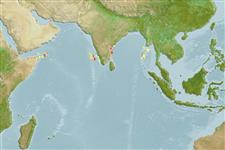
Western Indian Ocean: vicinity of Quilon, India (Ref. 244) and Sauqira Bay, Oman (Ref. 10914).
Dimensione / Peso / Età
Maturità: Lm ? range ? - 36.7 cm
Max length : 36.0 cm TL maschio/sesso non determinato; (Ref. 95495); 45.0 cm TL (female)
Breve descrizione
Chiavi di identificazione | Morfologia | Morfometria
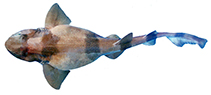
This is a small shark with the following characters: stout body with expanded belly; labial furrows absent but a vestigial lower labial furrow may be present; anterior nasal flaps are broadly triangular; head depressed, flattened and broad, rounded in dorsal and ventrally; mouth large and arched; 5 gill slits, dorsolaterally placed and last two gill slits over pectorals, the 1-3 gill slits are subequal in length, 5th smallest; eyes dorsolateral and slit like; large mouth, arched or crescentic; mouth width 0.6 times HL; first dorsal origin slightly in front of pelvic insertion and placed above pelvics (Ref. 95495).
Body shape (shape guide): elongated.
Found on the uppermost continental slope. Probably a dwarf species. Oviparous (Ref. 50499). This species could possibly attains a maximum size of 50.0 cm TL, with males reported (Ref. 26842) to reach length at maturity at 36.7 cm TL. A 45.0 cm female was found gravid and have two egg cases, one in each uterus, containing visible embryos (85.1-86.2 mm) with attached yolk sac. Stomach examined contains crustaceans and cephalopods (Ref. 95495).
Ciclo vitale e comportamento di accoppiamento
Maturità | Riproduzione | Deposizione | Uova | Fecondità | Larve
Oviparous, paired eggs are laid. Embryos feed solely on yolk (Ref. 50449).
Compagno, L.J.V., 1984. FAO Species Catalogue. Vol. 4. Sharks of the world. An annotated and illustrated catalogue of shark species known to date. Part 2 - Carcharhiniformes. FAO Fish. Synop. 125(4/2):251-655. Rome: FAO. (Ref. 244)
Stato della Lista Rossa IUCN (Ref. 130435: Version 2025-2 (Global))
Minaccia per l'uomo
Harmless
Usi umani
Pesca: di nessun interesse
Strumenti
Rapporti speciali
Scarica XML
Fonti Internet
Stime basate su modelli
Indice di diversità filogenetica (Fonte Biblio.
82804): PD
50 = 0.5000 [Uniqueness, from 0.5 = low to 2.0 = high].
Bayesian length-weight: a=0.00269 (0.00140 - 0.00518), b=3.21 (3.04 - 3.38), in cm total length, based on LWR estimates for this (Sub)family-body shape (Ref.
93245).
Livello trofico (Fonte Biblio.
69278): 4.0 ±0.5 se; based on size and trophs of closest relatives
Resilienza (Fonte Biblio.
120179): Basso, tempo minimo di raddoppiamento della popolazione 4.5 - 14 anni (Fec assumed to be <100).
Vulnerabilità della pesca (Ref.
59153): Low to moderate vulnerability (35 of 100).
🛈