>
Ovalentaria/misc (Various families in series Ovalentaria) >
Opistognathidae (Jawfishes)
Etymology: Opistognathus: Greek, opisthe = behind + Greek, gnathos = jaw (Ref. 45335); to the very elongate upper jaw of the type species of the genus, Opistognathus nigromarginatus (Ref. 128653).
More on author: Boulenger.
Entorno: milieu / zona climática / rango de profundidad / gama de distribución
Ecología
marino asociado a arrecife; rango de profundidad 15 - 50 m (Ref. 9710), usually 30 - 50 m (Ref. 27115). Tropical; 18°C - 24°C (Ref. 27115)
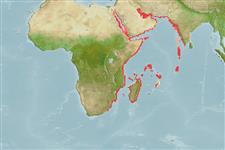
Western Indian Ocean: Durban, South Africa to the Persian Gulf, including Mahé Island, Seychelles (Ref. 5468). Not in Red Sea (Ref. 84159).
Tamaño / Peso / Edad
Madurez: Lm ? range ? - ? cm
Max length : 45.0 cm TL macho / no sexado; (Ref. 9710); common length : 30.0 cm TL macho / no sexado; (Ref. 5450)
Descripción breve
Claves de identificación | Morfología | Morfometría
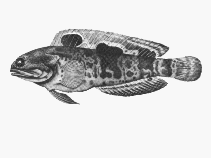
Espinas dorsales (total) : 11; Radios blandos dorsales (total) : 15; Espinas anales: 3; Radios blandos anales: 15. This species is distinguished by the following characters: short supramaxilla and mostly rigid maxilla with only a slight flexible lamina posteriorly; an ocellated spot on the dorsal fin, between third or fourth and eighth spines followed by two large, irregular, dark blotches that extend onto body, and a blackish streak on cheek bordering upper edge of maxilla; outermost segmented pelvic-fin ray is tightly bound to adjacent ray, with interradial membrane not incised distally or only slightly at tip (vs. interradial membrane deeply incised in all other Indo-Pacific Opistognathus (Ref. 81517).
Black spot between 3rd and 8th dorsal fin spines, fin also with 2 large blotches that extend onto body; body and dorsal fin with spots and blotches bordered with pale blue (Ref. 5468).
Body shape (shape guide): elongated.
This species is occasionally encountered in the fish market and its flesh is reported to be relatively good. It is taken incidentally in bottom trawls and by hook and line at 30-50 m (Ref. 81517).
Ciclo vital y comportamiento de apareamiento
Madurez | Reproducción | Puesta | Huevos | Fecundidad | Larva
Smith-Vaniz, W.F., 1986. Opisthognathidae. p. 726-727. In M.M. Smith and P.C. Heemstra (eds.) Smiths' sea fishes. Springer-Verlag, Berlin. (Ref. 5468)
Situación en la Lista Roja de la UICN (Ref. 130435: Version 2025-2 (Global))
Amenaza para el ser humano
Harmless
Usos humanos
Pesquerías: comercial; Acuario: Comercial
Herramientas
Informes especiales
Descargar XML
Fuentes de Internet
Estimaciones basadas en modelos
Temperatura preferida (Referencia
123201): 22.4 - 28.3, mean 26 °C (based on 73 cells).
Índice de diversidad filogenética (Referencia
82804): PD
50 = 0.5000 [Uniqueness, from 0.5 = low to 2.0 = high].
Bayesian length-weight: a=0.00389 (0.00180 - 0.00842), b=3.12 (2.94 - 3.30), in cm total length, based on all LWR estimates for this body shape (Ref.
93245).
Nivel trófico (Referencia
69278): 3.8 ±0.6 se; based on size and trophs of closest relatives
Vulnerabilidad pesquera (Ref.
59153): Low to moderate vulnerability (35 of 100).
🛈