>
Ovalentaria/misc (Various families in series Ovalentaria) >
Pomacentridae (Damselfishes) > Pomacentrinae
Etymology: Amphiprion: Greek, amphi = on both sides + Greek, prion, -onos = saw (Ref. 45335).
More on author: Bleeker.
Ambiente: milieu / zona climatica / distribuzione batimetrica / gamma di distribuzione
Ecologia
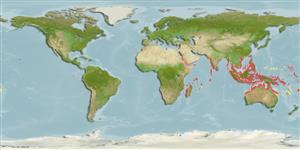
marino associati a barriera corallina; non migratori; distribuzione batimetrica 3 - 25 m (Ref. 9710). Tropical; 23°N - 35°S
Indo-West Pacific: East Africa, Madagascar, Comoro Islands, Seychelles, Andaman Sea, Sumatra and the Seribu Islands (Java Sea). Not found in Maldives and Sri Lanka (Ref. 4391).
Dimensione / Peso / Età
Maturità: Lm ? range ? - ? cm
Max length : 11.0 cm SL maschio/sesso non determinato; (Ref. 5911)
Breve descrizione
Chiavi di identificazione | Morfologia | Morfometria
Spine dorsali (totale) : 8 - 9; Raggi dorsali molli (totale) : 17 - 20; Spine anali: 2; Raggi anali molli: 12 - 14.
Body shape (shape guide): fusiform / normal; Cross section: compressed.
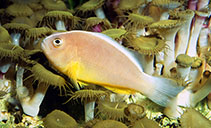
Found in shallow inshore reef habitats, often in strong current zones to about 15 m depth (Ref. 48636). Are protandrous hermaphrodites (Ref. 55367). Each pair is monogamous (Ref. 55367). Each anemone with a large female, a smaller functional male and several stunted juveniles; with the removal of the female, the male changes sex and the largest of the juveniles develops into a functional male (Ref. 4391). Oviparous, distinct pairing during breeding (Ref. 205). Eggs are demersal and adhere to the substrate (Ref. 205). Males guard and aerate the eggs (Ref. 205). Associated with the anemones: Heteractis magnifica, and Stichodactyla mertensii (Ref. 5911). May be reared in captivity (Ref. 35420).
Ciclo vitale e comportamento di accoppiamento
Maturità | Riproduzione | Deposizione | Uova | Fecondità | Larve
Benthic spawner. Sex reversal is completed in less than 63 days (Ref. 34185). Length at sex change = 7.2 cm TL (Ref. 55367). Oviparous, distinct pairing during breeding (Ref. 205). Eggs are demersal and adhere to the substrate (Ref. 205). Males guard and aerate the eggs (Ref. 205). Also Ref. 7471.
Allen, G.R., 1986. Pomacentridae. p. 670-682. In M.M. Smith and P.C. Heemstra (eds.) Smiths' sea fishes. Springer-Verlag, Berlin. (Ref. 4391)
Stato della Lista Rossa IUCN (Ref. 130435: Version 2025-2 (Global))
Minaccia per l'uomo
Harmless
Usi umani
Pesca: di nessun interesse; Acquario: Commerciale
Strumenti
Rapporti speciali
Scarica XML
Fonti Internet
Stime basate su modelli
Temperatura preferita (Fonte Biblio.
123201): 25.6 - 29.3, mean 28.6 °C (based on 2542 cells).
Indice di diversità filogenetica (Fonte Biblio.
82804): PD
50 = 0.5000 [Uniqueness, from 0.5 = low to 2.0 = high].
Bayesian length-weight: a=0.01445 (0.00624 - 0.03346), b=3.00 (2.81 - 3.19), in cm total length, based on LWR estimates for this (Sub)family-body shape (Ref.
93245).
Livello trofico (Fonte Biblio.
69278): 2.7 ±0.31 se; based on food items.
Resilienza (Fonte Biblio.
120179): Alto, tempo minimo di raddoppiamento della popolazione meno di 15 mesi (Preliminary K or Fecundity.).
Vulnerabilità della pesca (Ref.
59153): Low vulnerability (10 of 100).
🛈
Nutrienti (Ref.
124155): Calcium = 111 [62, 177] mg/100g; Iron = 0.785 [0.498, 1.219] mg/100g; Protein = 18.6 [17.5, 19.6] %; Omega3 = 0.146 [0.094, 0.224] g/100g; Selenium = 21.5 [12.8, 38.2] μg/100g; VitaminA = 143 [49, 416] μg/100g; Zinc = 2.07 [1.45, 2.84] mg/100g (wet weight);