Ελασμοβράγχιοι (καρχαρίες και σαλάχια) (sharks and rays) >
Carcharhiniformes (Ground sharks) >
Pentanchidae (Deepwater catsharks)
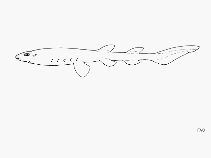
Etymology: Cephalurus: cephalus, from kephale (Gr.), head, referring to its expanded, flattened and rounded head; ailouros (Gr.), cat, probably an allusion to the vernacular “catshark,” so named for its cat-like eyes (See ETYFish); cephalus: From kephale (Gr.), head, allusion not explained, probably referring to its expanded, flattened and rounded head, “much wider” and with larger pores compared with the similar Parmaturus xaniurus, its presumed congener at the time (See ETYFish).
More on author: Gilbert.
Περιβάλλον: περιβάλλον / κλιματική ζώνη / εύρος βάθους / εύρος διανομής
Οικολογία
Θαλασσινό(ά) βαθύβιο(ς); εύρος βάθους 155 - 927 m (Ref. 244). Deep-water; 32°N - 15°S
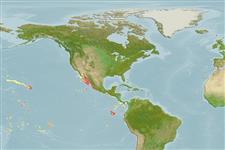
Eastern Central Pacific: southern Baja California, Mexico and Gulf of California. Cephalurus specimens from Panama, Peru and Chile differ from Cephalurus cephalus and may represent one or more new species.
Μήκος κατά την πρώτη ωρίμανση / Μέγεθος / Βάρος / Ηλικία
Γεννητική Ωρίμανση: Lm ?, range 19 - ? cm
Max length : 28.0 cm TL αρσενικό/απροσδιόριστο; (Ref. 244); common length : 24.0 cm TL αρσενικό/απροσδιόριστο; (Ref. 244)
Σύντομη περιγραφή
Κλείδες προσδιορισμού | Μορφολογία | Μορφομετρία
Found on the upper continental slope and outermost shelf. The expanded branchial region of this shark suggests that they are adapted to bottom areas with low dissolved oxygen levels. With little information available, reproductive mode could either be ovoviviparous (Ref. 244, 53776) or oviparous, paired eggs are laid (Ref. 50449).
Oviparous, paired eggs are laid. Embryos feed solely on yolk (Ref. 50449). Other sources describe ovoviviparity as an alternative reproductive mode (Ref. 244, 53776).
Compagno, L.J.V., 1984. FAO Species Catalogue. Vol. 4. Sharks of the world. An annotated and illustrated catalogue of shark species known to date. Part 2 - Carcharhiniformes. FAO Fish. Synop. 125(4/2):251-655. Rome: FAO. (Ref. 244)
Κατάσταση Κόκκινου Καταλόγου IUCN (Ref. 130435: Version 2025-2 (Global))
Απειλή για τον άνθρωπο
Harmless
Ανθρώπινες χρήσεις
αλιεία: χωρίς ενδιαφέρον
Εργαλεία
Ειδικές εκθέσεις
Λήψη XML
Διαδικτυακές πηγές
Εκτιμήσεις βάσει μοντέλων
Προτιμώμενη θερμοκρασία (Αναφ.
123201): 7.9 - 14.8, mean 9.5 °C (based on 31 cells).
Δείκτης φυλογενετικής ποικιλότητας (Αναφ.
82804): PD
50 = 1.0000 [Uniqueness, from 0.5 = low to 2.0 = high].
Bayesian length-weight: a=0.00398 (0.00237 - 0.00669), b=3.05 (2.90 - 3.20), in cm total length, based on LWR estimates for this species & (Sub)family-body (Ref.
93245).
Τροφικό Επίπεδο (Αναφ.
69278): 3.7 ±0.4 se; based on diet studies.
Ελαστικότητα (Αναφ.
120179): Πολύ χαμηλό, ελάχιστος χρόνος για διπλασιασμό πληθυσμού > 14 έτη (Fec=2).
Ευπάθεια στην αλιεία (Ref.
59153): Low vulnerability (18 of 100).
🛈